1% of Memecoin Wallets Took 87% of the Profit
On this page
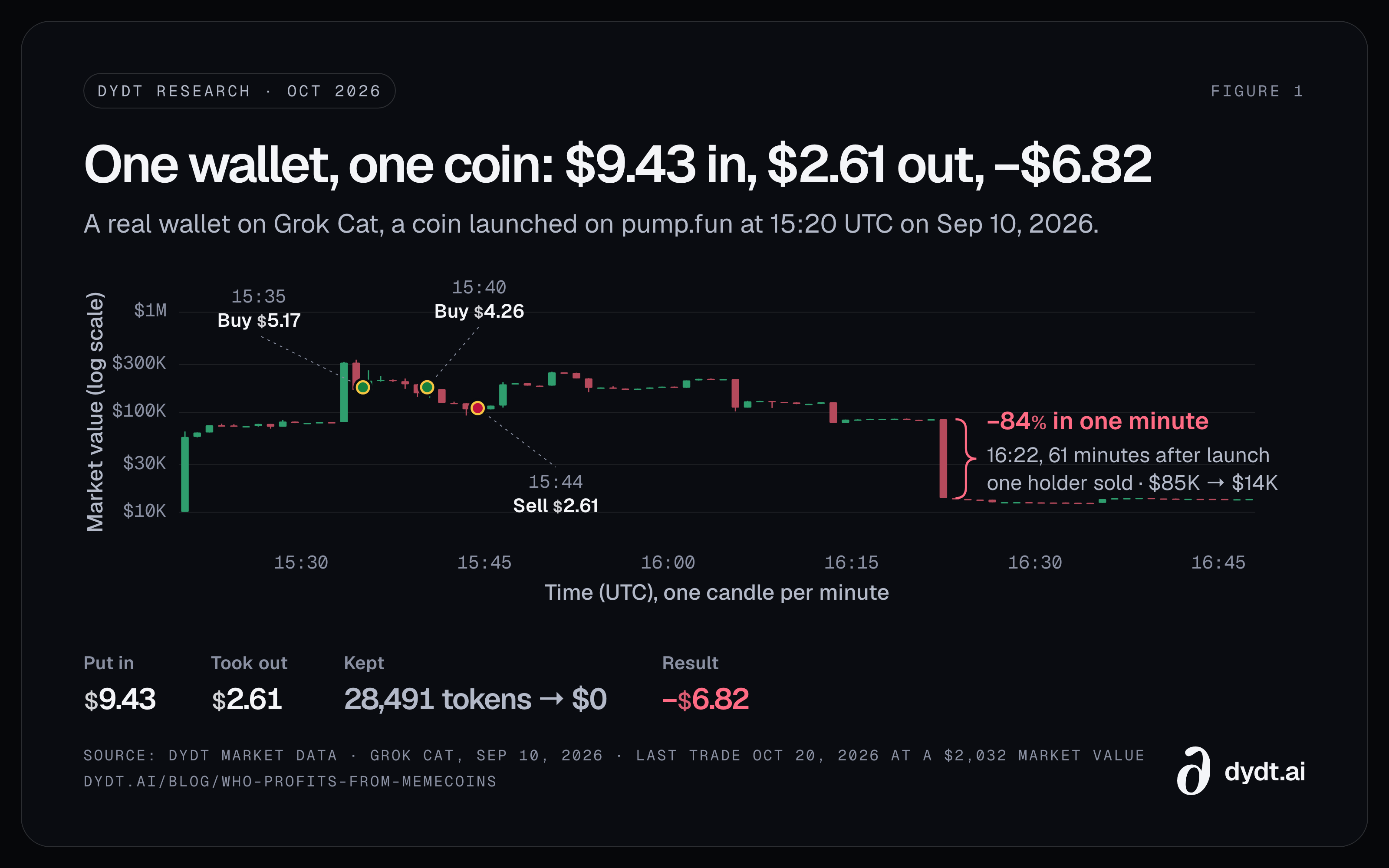
At 15:20 UTC on September 10, 2026, a new coin called Grok Cat went live on pump.fun. Fifteen minutes later its market value had passed $170,000, and one more buyer decided to get in.
That wallet spent $5.17, then another $4.26 five minutes later. Four minutes after that it sold a small part of its position for $2.61 and held on to the rest. At 16:22, an hour after the launch and 38 minutes after our wallet's sale, one large holder sold, and the coin lost 84% of its value inside a minute. It never came back. The wallet finished $6.82 down.
Lose a few dollars, move on to the next coin: for most people who buy memecoins, that is the whole story. But every one of those losing trades had someone on the other side, and some of them did very well. We wanted to know who.
So we followed every wallet that bought any of the 404,210 coins launched on pump.fun between September 2 and 15, 2026. That came to 4,735,045 wallets, and we tracked each of them for five to seven weeks. About 15 in 100 made money. The most profitable 1% of wallets collected 87% of all the profit, and many of the biggest winners were the wallets that had created the coins in the first place.
Key findings
- About 15 in 100 wallets made money. Half of all wallets lost $3.37 or more.
- Half of all wallets got back less than 11 cents for every dollar they spent.
- 1% of wallets took 87% of all the profit, far more lopsided than the familiar 80/20 rule.
- Only five of 4.7 million wallets made more than $1 million.
- The biggest winners were often first in line: they created the coin, or bought it within two seconds of its launch.
- The busiest wallets did best. Wallets that bought more than 1,000 different coins in two weeks made money 62% of the time.
There is also a six-minute video of this study on the dydt YouTube channel.
How a pump.fun coin works
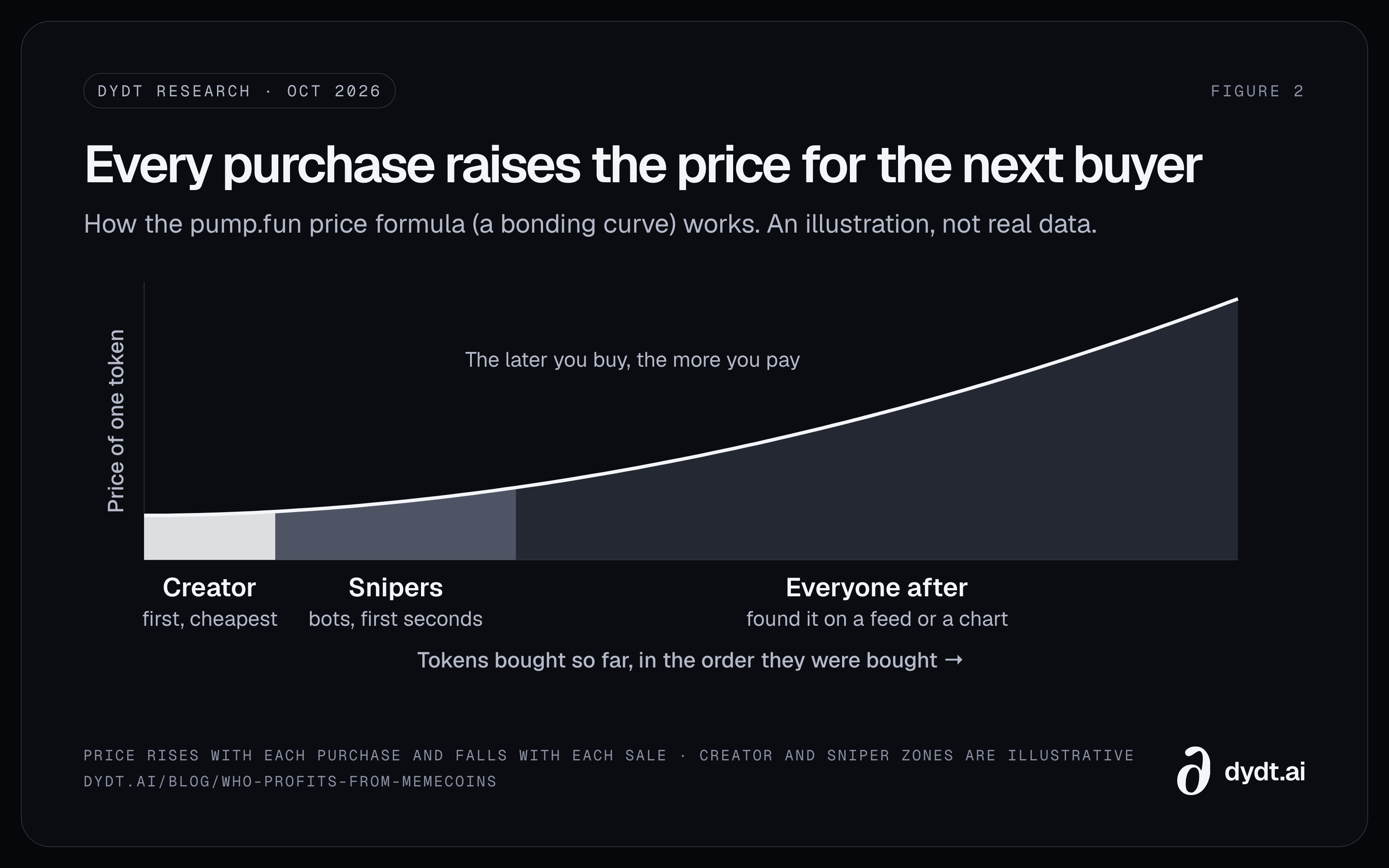
Pump.fun lets anyone create a coin in a few minutes. There is no company behind most of these coins and no order book; a fixed formula sets the price, and every purchase pushes it up for the next buyer.
The formula is called a bonding curve. When someone buys, the price rises a little; when someone sells, it falls by the same rule. So for as long as buyers outnumber sellers, the price keeps climbing: the earliest buyers pay the least, and each later buyer pays a little more. When sellers take over, it falls just as mechanically. The curve sets the price until a coin graduates to a regular trading pool (crypto.news explains the formula).
That one rule decides a lot. The cheapest moment to buy is the first second of a coin's life, and the wallet best placed to buy then is the one that created it. Close behind are automated buyers, usually called snipers, that watch for new coins and buy within a second or two. Everyone who finds the coin later, through a feed, a chart or a post, buys at a higher price, often from them.
Most of these coins also die young. Two in three of the coins in this study had their last trade within an hour of launch, and only 1.6% were still trading five weeks later.
Most wallets lost, and most lost a little
We scored each wallet in the simplest way possible: money taken out minus money put in, across every new coin it bought. By that measure, about 15 in 100 wallets made money.
Tokens a wallet never sold count as zero, because for almost all of these coins there was nobody left to sell to. Even if we value every unsold token at the coin's last traded price, the share of wallets in profit only rises from 14.7% to 16.4%.
That is a stricter test than the one behind a widely quoted figure from CoinGecko, which found that 73% of pump.fun traders were in profit in April 2026 (CoinGecko Research). CoinGecko counts only profits that were actually realized, so a wallet that bought, never sold and watched the coin go to zero does not appear in its numbers. Here, every wallet that bought counts.
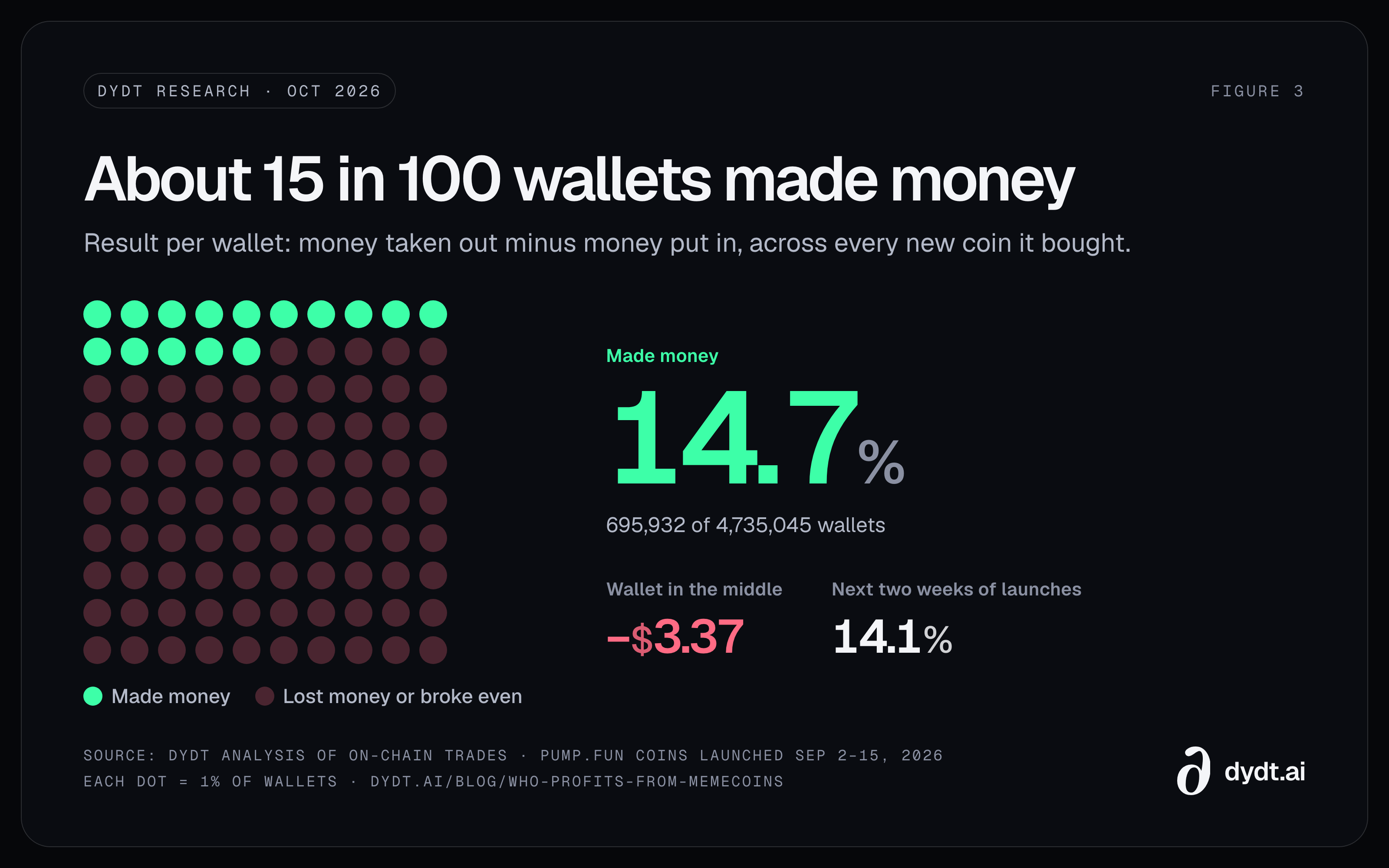
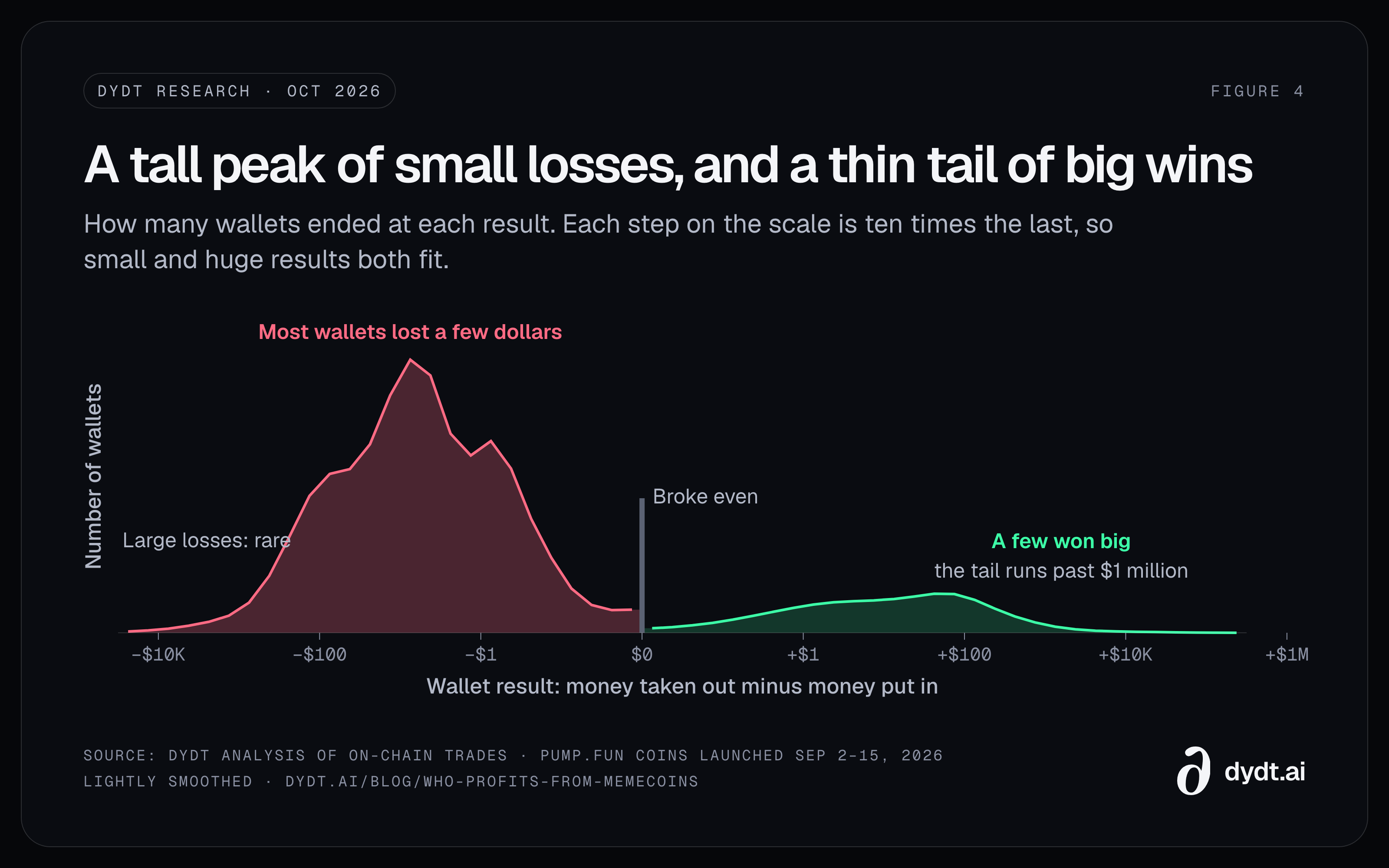
Most losses were small, because most bets were small. Line every wallet up from the worst result to the best, and the one in the middle lost $3.37. Half of all wallets lost less than $10. Plot every wallet's result and the shape is striking: a tall peak of small losses just below zero, and a long, thin tail of winners stretching far to the right.
When we repeated the whole study on the next two weeks of launches, September 16 to 29, the answer barely moved: 14.1% of wallets made money.
Half got back less than 11 cents per dollar
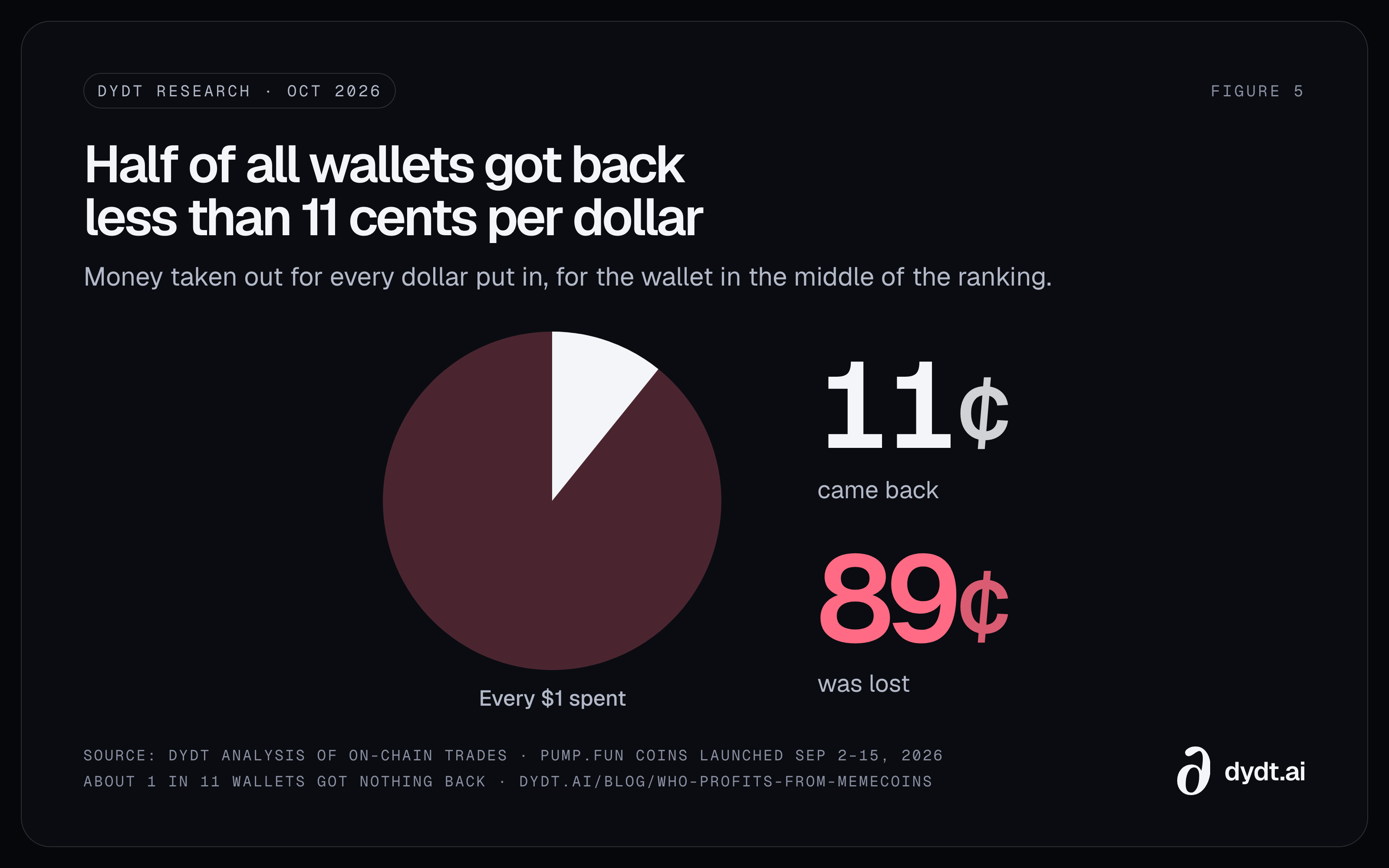
Small losses are easy to shrug off, but measured against what was spent they are large. Half of all wallets got back less than 11 cents for every dollar they put in, and about one in 11 got nothing back at all.
Spending more did improve the odds, but only up to a point, and it made the losses bigger:
| Total spent | Wallets | Made money | Wallet in the middle |
|---|---|---|---|
| Under $10 | 2,285,192 | 7.8% | −$0.83 |
| $10–100 | 1,210,888 | 15.0% | −$12.94 |
| $100–1K | 1,041,216 | 27.4% | −$48.77 |
| $1K–10K | 162,732 | 25.2% | −$315 |
| $10K–100K | 31,305 | 24.8% | −$2,533 |
| $100K+ | 3,743 | 24.3% | −$48,846 |
About one in four big spenders made money, but half of the wallets that spent more than $100,000 lost $48,846 or more.
1% of wallets took 87% of the profit
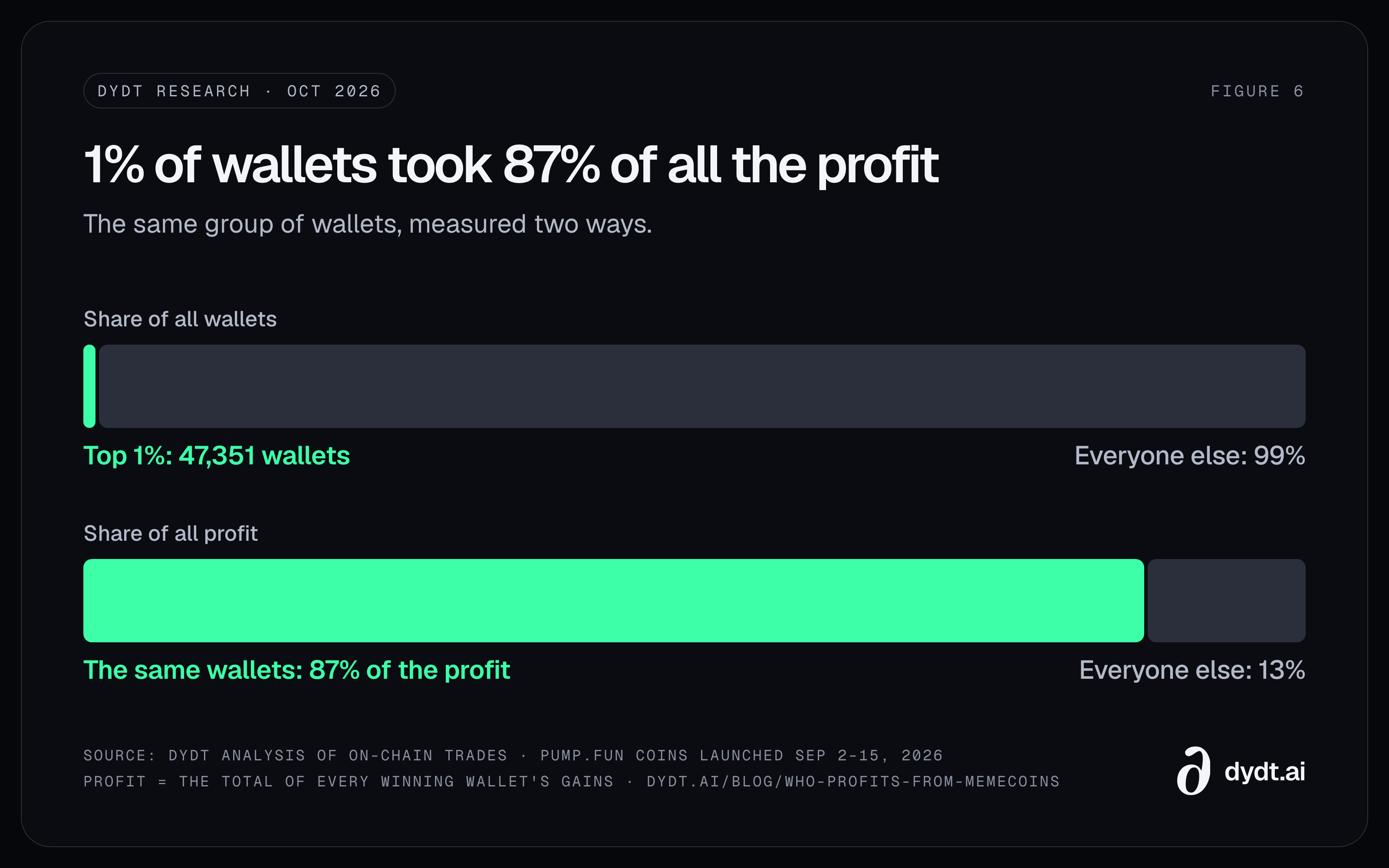
Add up every dollar of profit made by every winning wallet, and almost all of it went to a small group. The most profitable 1% of wallets, about 47,000 of them, collected 87% of it.
Economists often quote the Pareto principle, the rough rule that 80% of the results come from 20% of the people. Memecoin profits are far more concentrated than that: here, 1% of wallets took 87%, and the top 0.1%, fewer than 5,000 wallets, took 62% on their own.
Losses were concentrated too. The 1% of wallets with the biggest losses accounted for 85% of all the money lost. Many of them are high-volume accounts that move large sums through thousands of coins; one spent $39.8 million on 2,767 coins and took out $0.38 million.
Big wins are real, and very rare
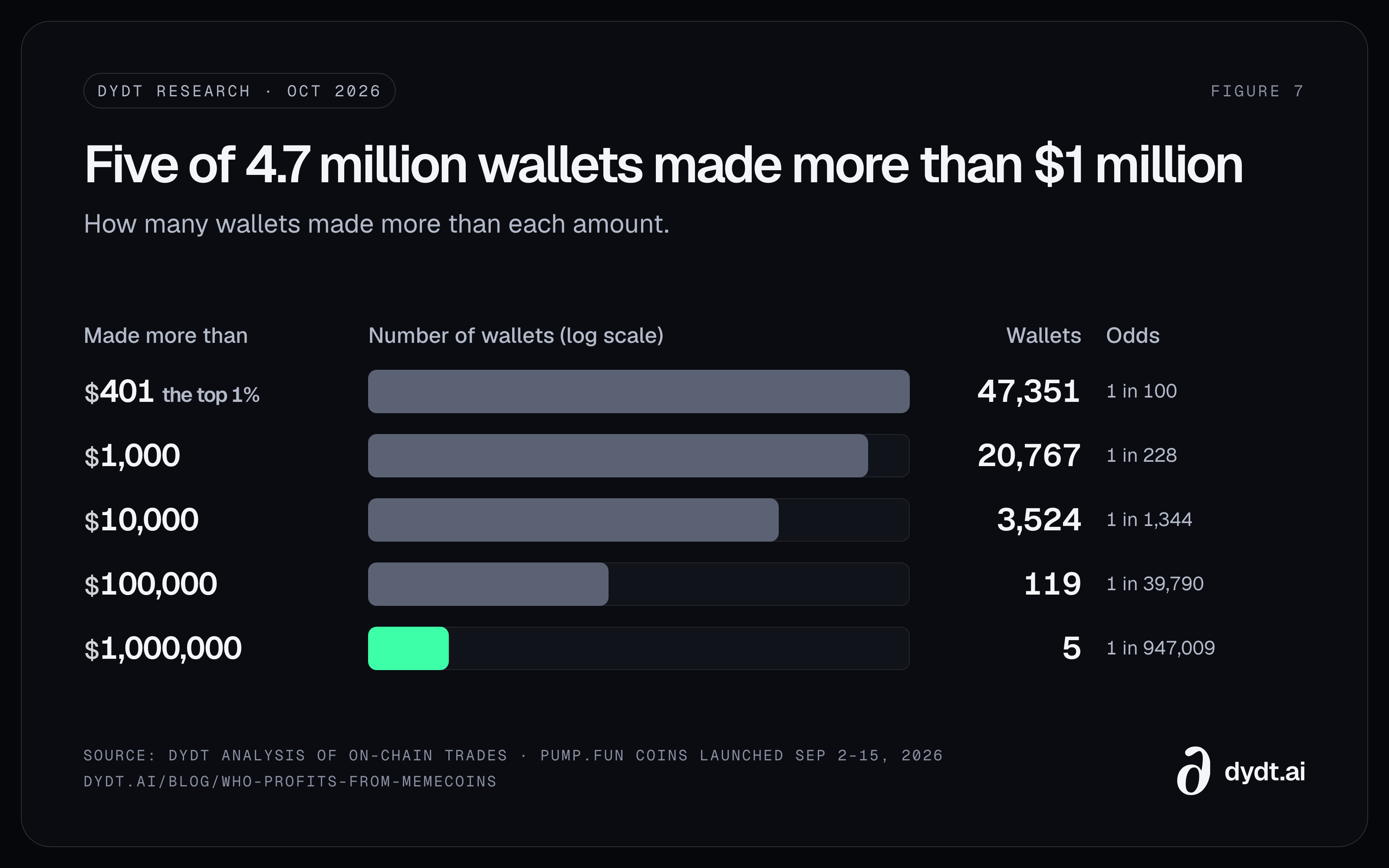
20,767 wallets made more than $1,000. Only 119 made more than $100,000, and five made more than $1 million: about one wallet in a million.
Who the big winners are
The bonding curve explains most of it. The larger the win, the more likely it came from being first: creating the coin, or buying it within two seconds of launch.
For the 119 wallets that made more than $100,000, coins they had created themselves supplied 39% of their profit, and buying in the first two seconds supplied another 19%. Across the whole top 1%, the first-two-seconds buys mattered even more, supplying 39% of the profit.
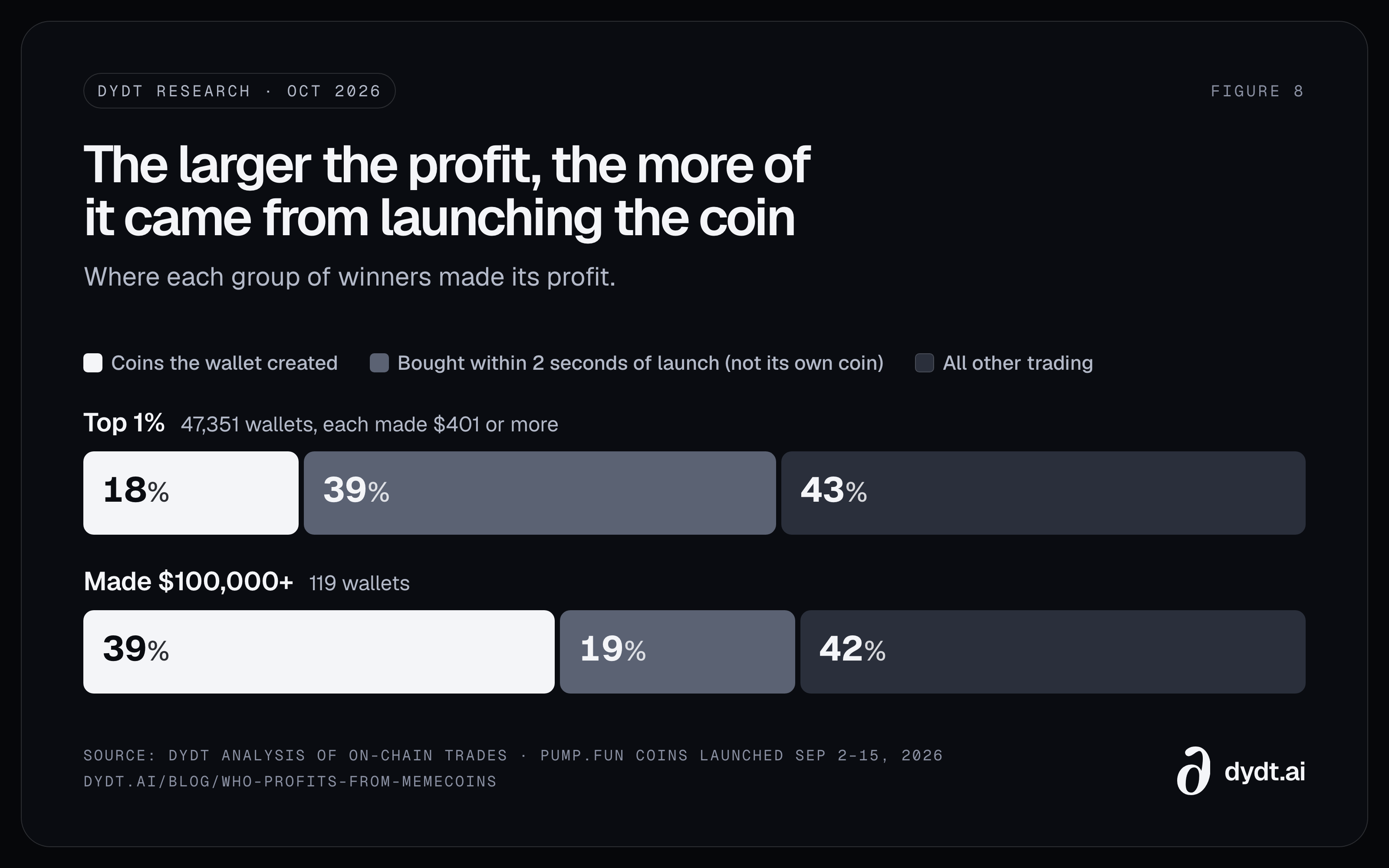
Looking at the 119 wallets one by one, 56 made most of their money on a coin they had created, 27 by buying in the first two seconds, and 36 by ordinary trading. Even most of those 36 traders depended on a single lucky coin: 27 of them made at least 90% of their profit on one coin.
The five millionaires tell the same story in miniature. Two of them each created a single coin, spent about $9,000 on it and took out about $1.1 million.
The busiest wallets did best
Wallets that bought one coin made money 15% of the time. Wallets that bought more than 1,000 different coins made money 62% of the time, and half of them made $170 or more.
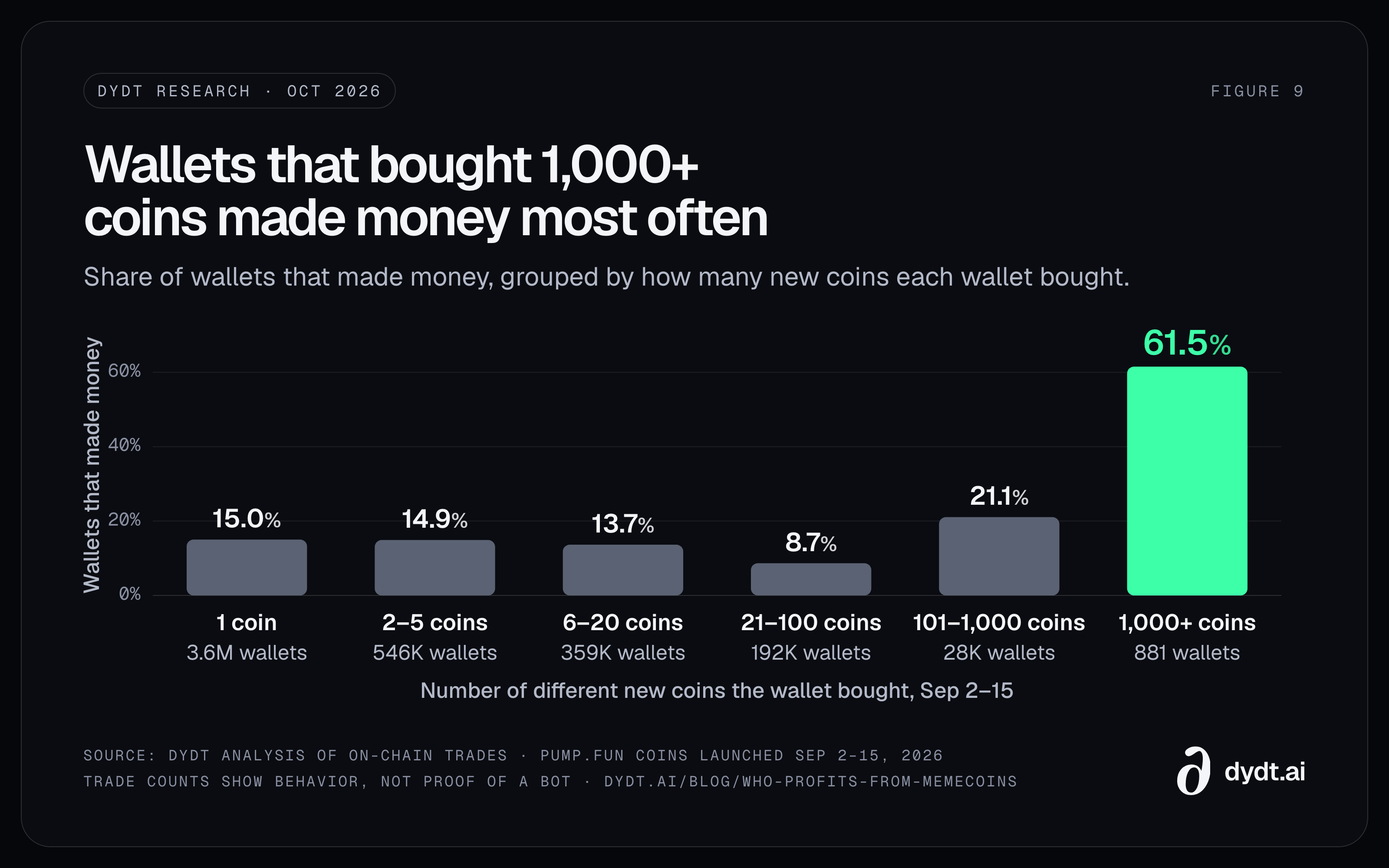
More than 1,000 coins in two weeks is over 70 new coins a day, every day, a pace that points to automated trading. We can see how often a wallet trades, not who runs it, so this describes behavior rather than proving that bots are involved. The worst results came in between: wallets that bought 21 to 100 coins made money only 8.7% of the time.
What this means if you buy memecoins
The data does not say "never buy". It shows where the odds sit, and three habits follow from it.
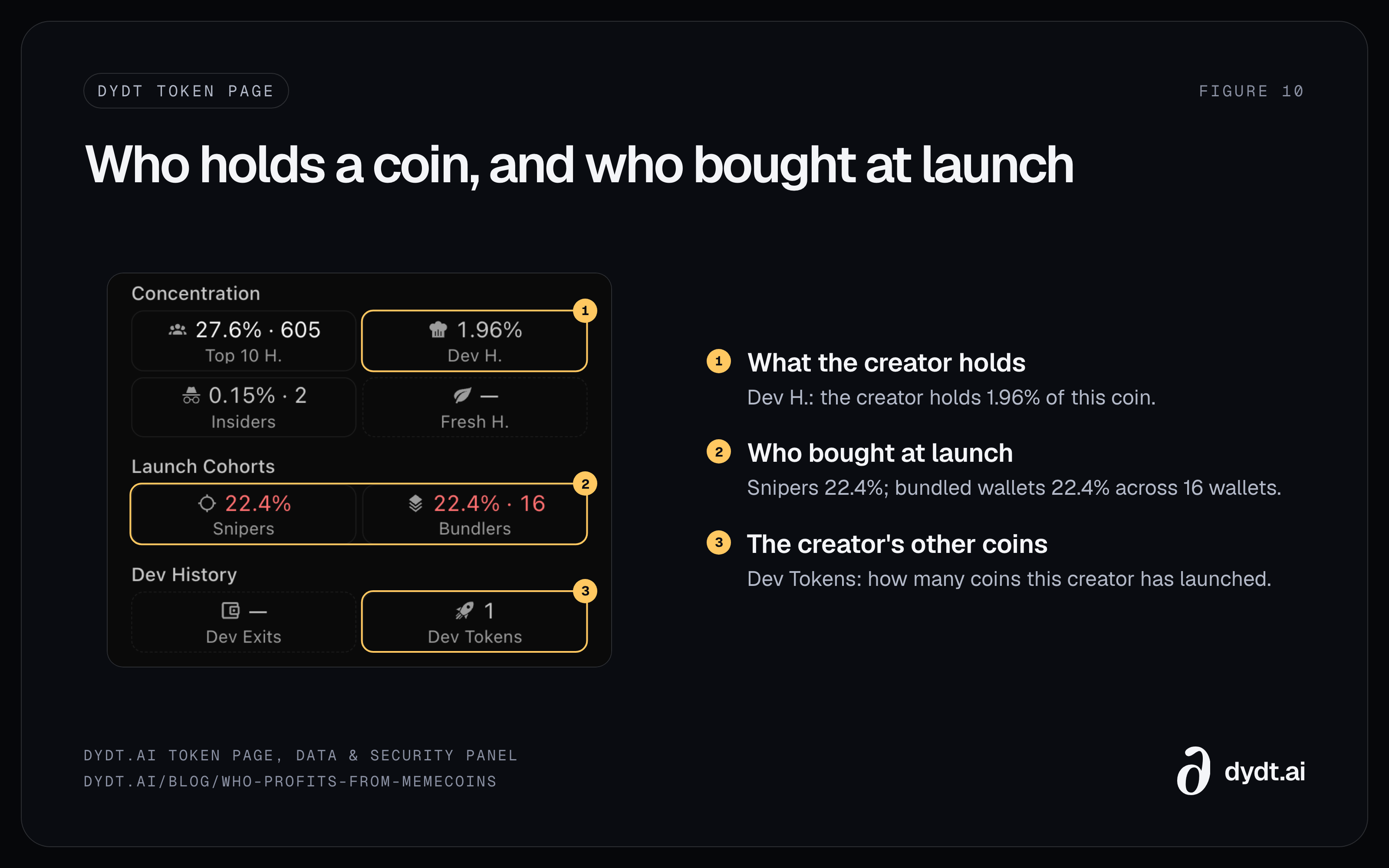
Know where you stand in the queue. The cheapest tokens go to the creator and to the bots that buy in the first seconds. By the time a coin shows up on a feed or a chart, they already hold it, and they are the ones selling to everyone who arrives later. Before buying, check how much of the coin its creator still holds, how much went to snipers and to bundled wallets (several wallets buying together at launch, often run by one person), and how many coins the same creator has launched before. If those early holders still own a large share, you are buying from them.
Set your buy size and your selling plan before you buy. Two in three coins in this study stopped trading within an hour of launch, so every buy is a short bet that may not pay back. Choose a fixed amount per coin that keeps you in the game through a run of misses, and decide in advance the price at which you will take profit and the point at which you will cut the loss. Deciding before you buy, rather than while the price is moving, protects the rest of your balance.
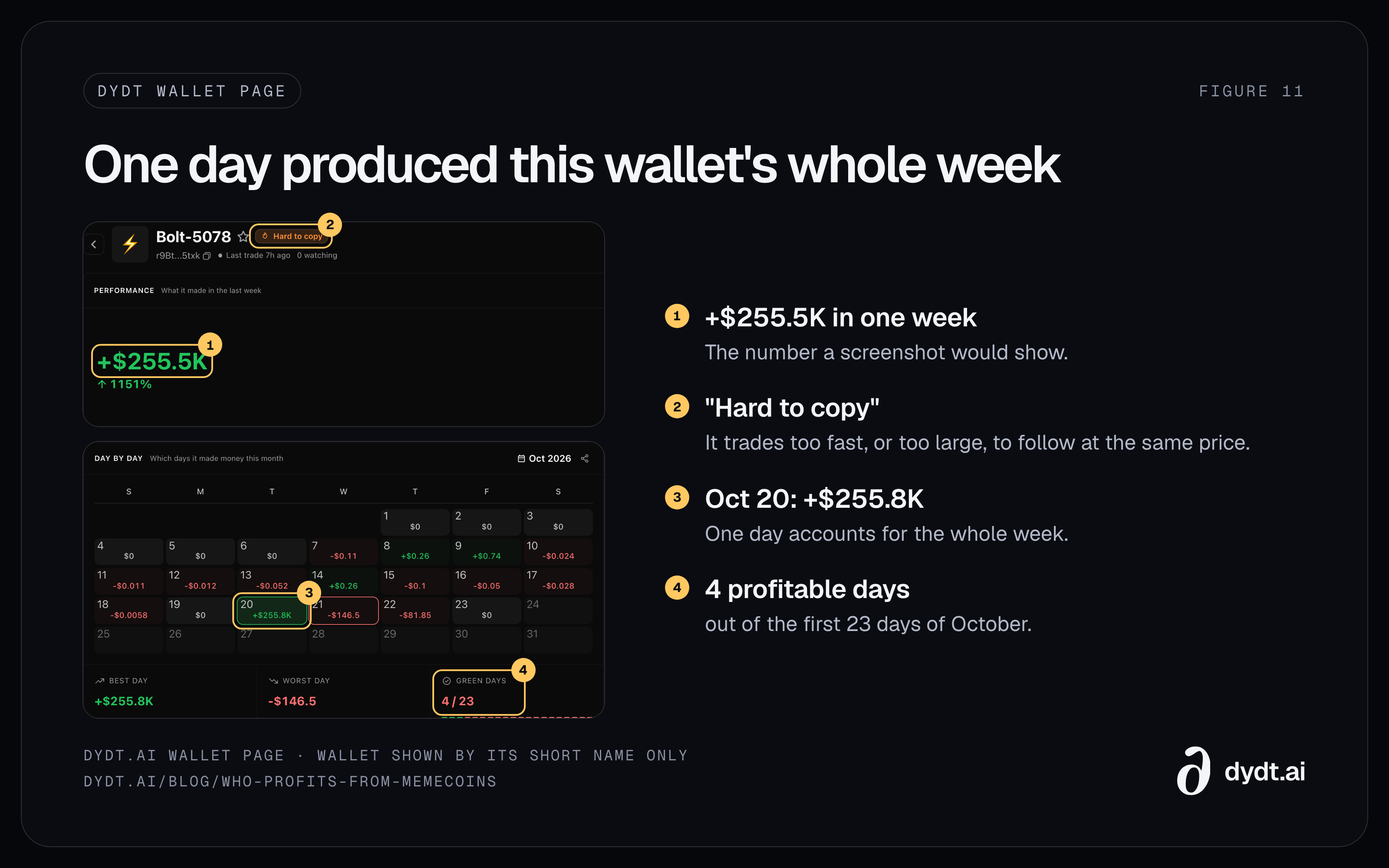
Judge results over weeks, not by the best trade. Even among the biggest winners, most made nearly all their profit on a single coin, and one big win can hide a long run of small losses. Look at your own record as a whole, and hold any trader you think of following to the same test. The wallet below made $255,500 in a week, all of it on one day, and made money on only four of the first 23 days of October.
The Grok Cat wallet from the start of this story did nothing wrong by the standards of the market. It bought a new coin the way millions of others did, and it ended where most of them ended. What separated the winners in this study was rarely a better pick. More often, it was their place in the queue.
On dydt. Your portfolio page shows your own record across every coin you have traded, day by day. Every token page carries the Data & Security panel shown above, and every wallet page shows the record behind a trader's headline number.
About this research
Why we did this. Memecoin trading is mostly discussed through individual wins shared on social media. We wanted the full picture: every wallet that bought a new coin, scored the same way.
How we did this. We took every coin launched on pump.fun between September 2 and 15, 2026 (404,210 coins) and every wallet that bought at least one of them (4,735,045 wallets). On October 22, 2026, after five to seven weeks of trading for each coin, we scored every wallet as the dollars it received from selling minus the dollars it spent buying, across all of those coins. We then repeated the study on the 510,996 coins launched between September 16 and 29 (4,230,727 wallets).
What the terms mean.
- Wallet: an account on the Solana blockchain. One person can run many wallets, and automated wallets are included.
- Made money: the wallet took out more dollars than it put in.
- The wallet in the middle: the median. Half of all wallets did better and half did worse.
- Created the coin: the wallet launched it on pump.fun.
- First two seconds: the wallet's first purchase came within two seconds of the launch, on a coin it did not create.
- Unsold tokens count as zero. Valuing them at each coin's last traded price instead raises the share of wallets in profit from 14.7% to 16.4%, an upper limit because most of those coins had no buyers left.
Limitations.
- If a wallet sold more tokens than it bought, for example tokens sent to it by another wallet, only the part it bought counts.
- We left out 8,161 positions that held more than 20% of a coin's supply. These belong to pump.fun's own accounts, which hold coins while they move to a new market, not to buyers.
- The study covers coins launched on pump.fun and their trades on the markets dydt tracks.
- Shares of total profit and total loss are driven by a few thousand very large accounts. Wallet counts and the middle results are the steadier measures.
- Some of the largest results, winning and losing, may belong to bots or to wallets trading with themselves to inflate volume.
- The study describes coins launched in September 2026. It does not predict future results.
Data. All figures come from dydt's index of on-chain Solana trades. Results describe the coins and dates above; later trades on the same coins can shift them slightly.
How to cite this research
dydt research. "1% of Memecoin Wallets Took 87% of the Profit." dydt, October 29, 2026. https://dydt.ai/blog/who-profits-from-memecoins
Disclosure. This is not financial advice. Memecoins are highly speculative and can lose all of their value. dydt operates a trading terminal, and the product pages shown are dydt's own.
Frequently asked questions
Do people actually make money on memecoins?
In a dydt study of 4,735,045 wallets that bought new pump.fun coins between September 2 and 15, 2026, about 15 in 100 (14.7%) made money after five to seven weeks of trading. The same study on the following two weeks of launches found 14.1%.
Who makes the most money from memecoins?
The most profitable 1% of wallets took 87% of all profit. Among wallets that made more than $100,000, the coins they created themselves supplied 39% of their profit, and buying within two seconds of a launch supplied another 19%.
How much does the average memecoin buyer lose?
Half of all wallets in the study lost $3.37 or more, and half lost less than $10. Measured against what they spent, half of all wallets got back less than 11 cents per dollar.
Do pump.fun snipers make money?
Buying within two seconds of a launch supplied 39% of the profit of the top 1% of wallets. This describes the winners only; the study does not show that buying fast is profitable on average.
Does spending more on memecoins improve the odds?
Up to a point. 7.8% of wallets that spent under $10 made money, compared with 27.4% of those that spent $100 to $1,000. Above $1,000 the share stayed near 25%, while the losses kept growing.
Table of Contents
© dydt.ai — real-time Solana trading terminal. Not financial advice.