Solana Trading Fees: What You Actually Pay
On this page
You close a clean Solana trade, but the profit never reaches your PnL. Twenty dollars left on the buy and twenty more on the sell—the platform cut travelled inside the swap.
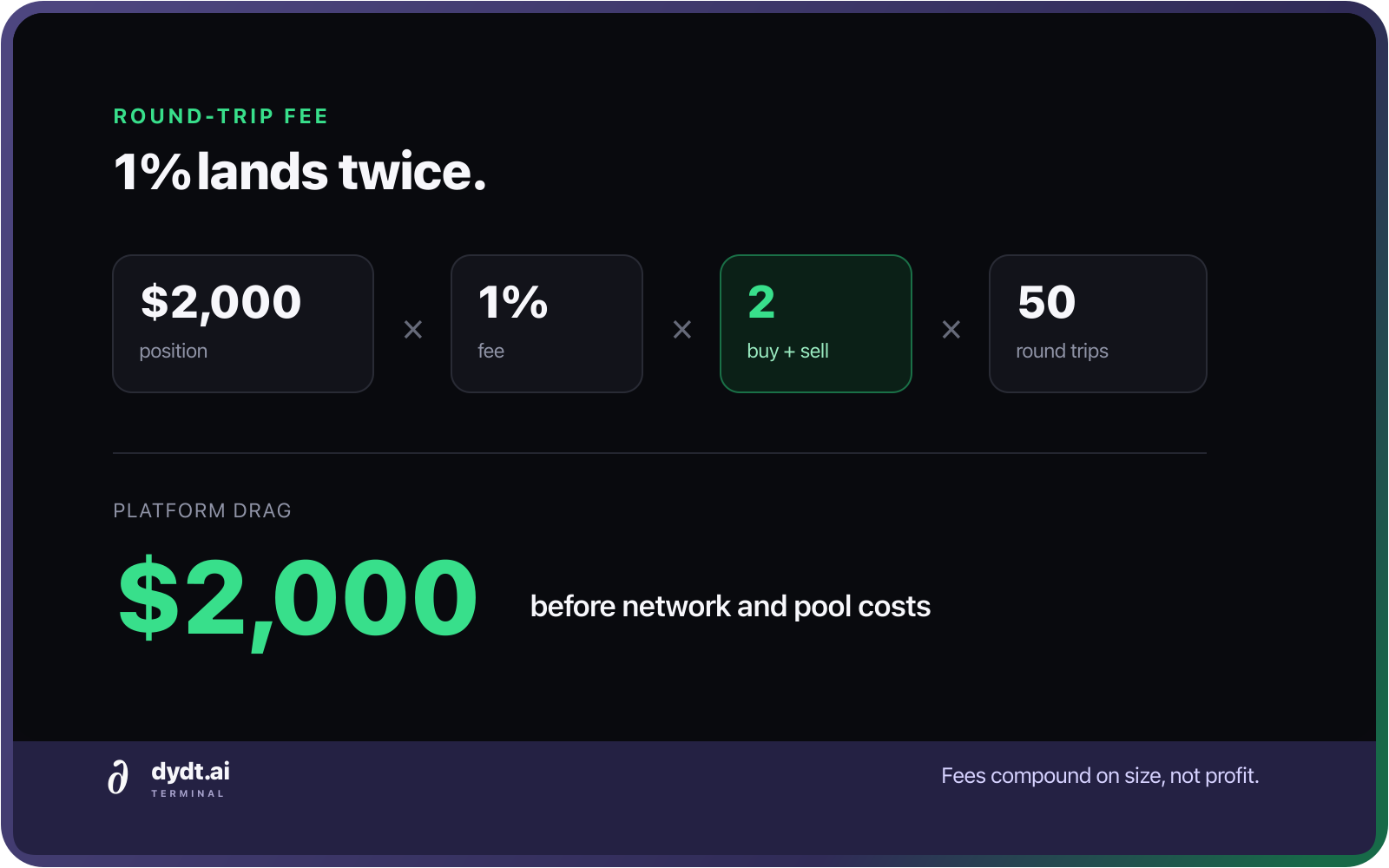
At $2,000 per position, fifty round trips at a 1% platform fee cost $2,000. The transaction shows it. Most PnL screens do not.
This guide maps every cost, shows how to audit any terminal in ninety seconds, and compares rates we could verify from first-party documentation.
Up front: dydt charges no platform trading fee during launch. Network, pool and execution costs still apply.
The short version: A 1% platform fee becomes 2% across a buy and sell. At $2,000 per position and 50 round trips, that is $2,000 in platform fees. On dydt during launch, the same platform-fee line is $0. Network costs, pool fees and price impact still apply.
The fee is not 1%. It is 2%.
Platform fees are charged on position size, not profit. They also land twice: once entering and once exiting. A published 1% rate therefore becomes 2% across a round trip—even when the trade loses.
At $2,000 per position:
| Platform fee | Per round trip | 10 trips | 50 trips | 200 trips |
|---|---|---|---|---|
| 1.00% | $40 | $400 | $2,000 | $8,000 |
| 0.75% | $30 | $300 | $1,500 | $6,000 |
| 0.50% | $20 | $200 | $1,000 | $4,000 |
| 0.00% | $0 | $0 | $0 | $0 |
Calculate your platform-fee drag
Enter your usual size and frequency. This excludes network, pool and execution costs.Use: average size × 2 × fee rate × round trips. A 2% round-trip drag can erase short holds before price impact is counted.
Seven things get called "a fee" on a Solana trade
Seven costs can appear in one transaction, but they pay four different recipients.
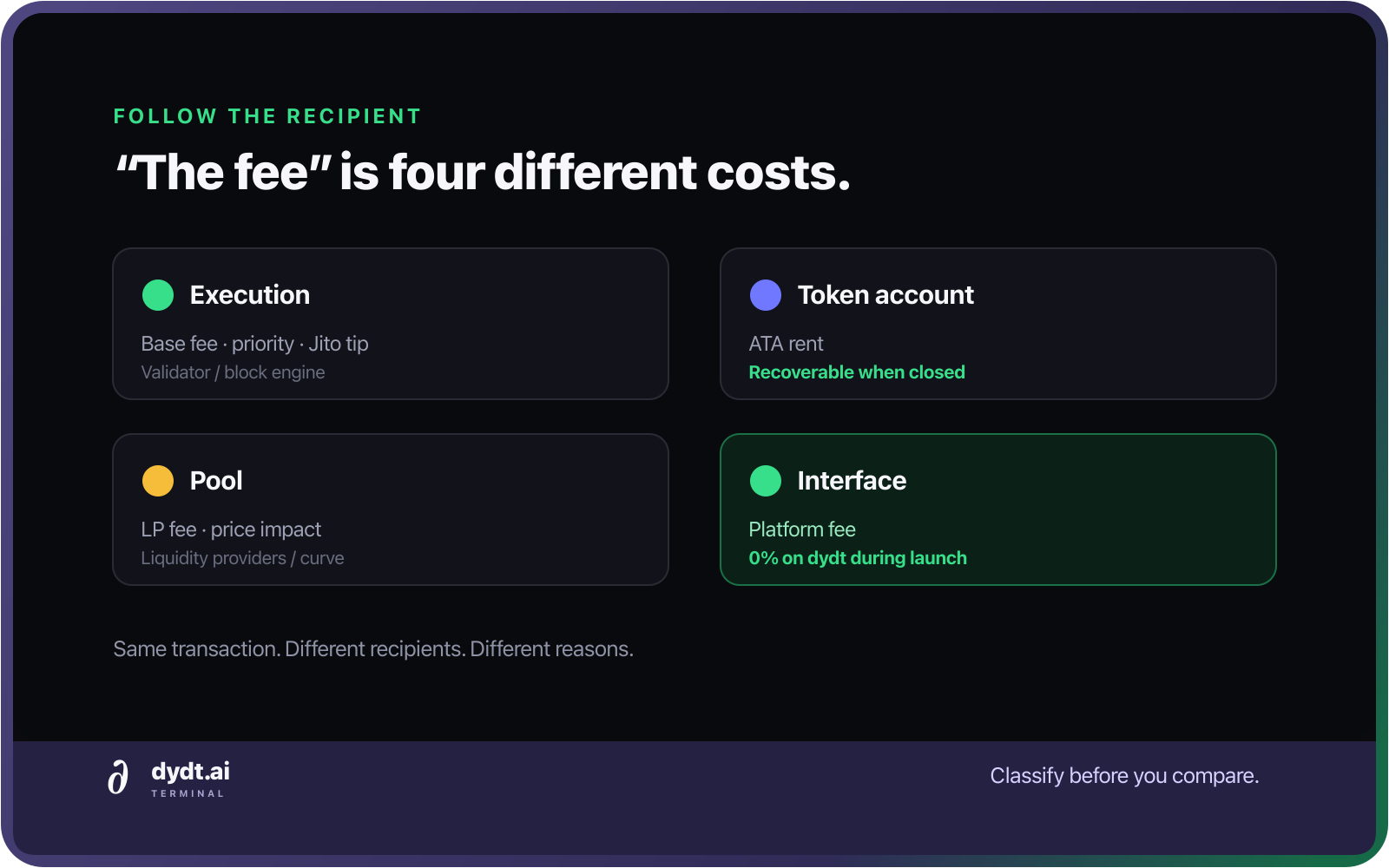
Base network fee. 5,000 lamports per signature—0.000005 SOL—paid for Solana execution. (Solana docs)
Priority fee. A per-compute-unit bid for a better place in the validator queue.
Jito tip. An optional payment for faster or protected inclusion through a block engine.
Account rent. Creating an Associated Token Account locks 0.00203928 SOL. Close the empty account and the deposit returns. (QuickNode on Solana rent)
Pool / LP fee. The AMM's cut for liquidity providers. Raydium AMM v4 uses 0.25%; other pools vary. (Raydium docs, Raydium vs PumpSwap)
Price impact. The movement caused by your own order. In thin liquidity, it can exceed every explicit fee combined.
Platform fee. The terminal's revenue cut. It buys no blockspace, liquidity or inclusion.
The first six come from using the chain and pool. The seventh is a business model—and the ledger lets you verify it.
The ninety-second audit of your own terminal
What a PnL screen omits, the transaction records.
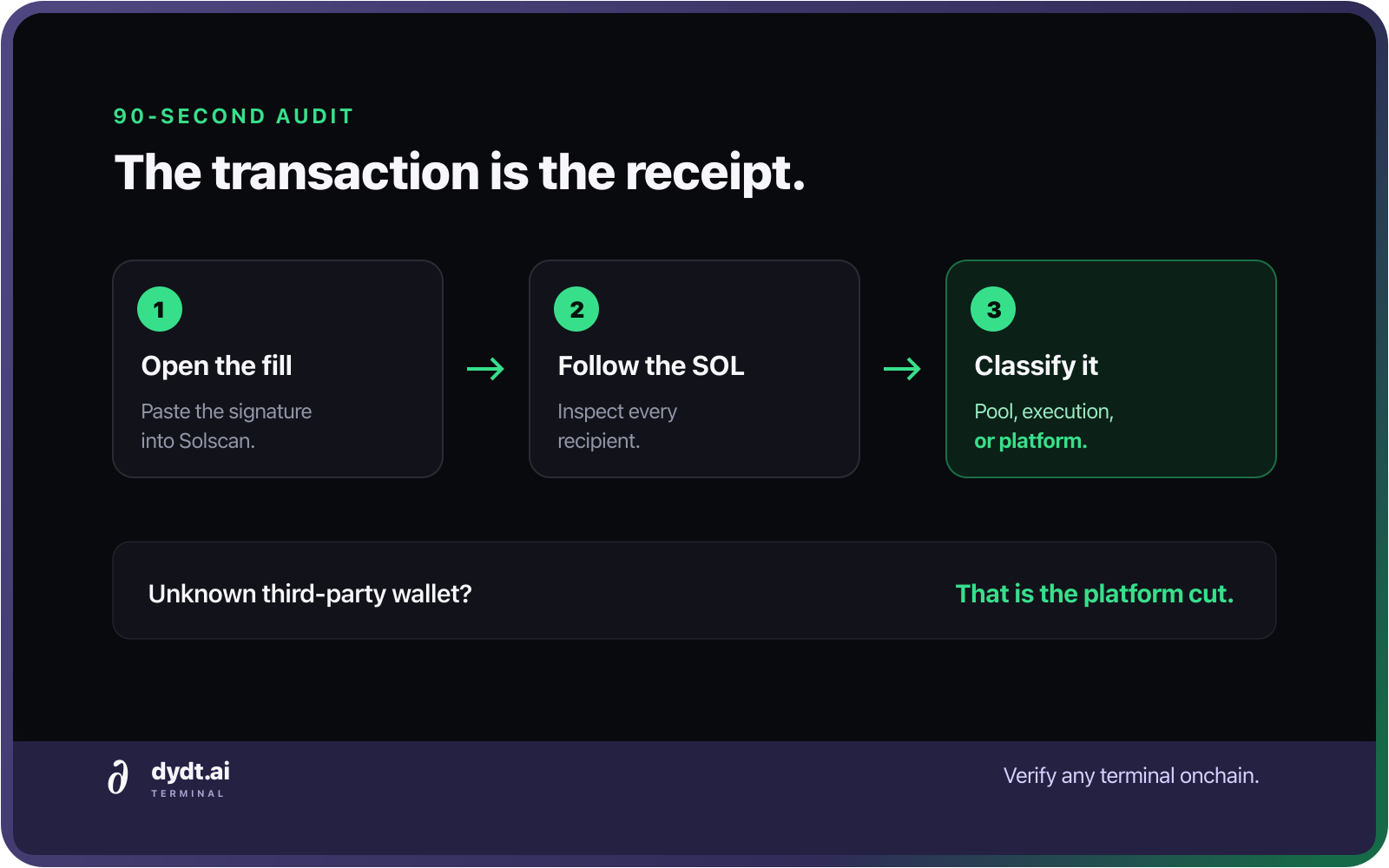
- Open one fill. Copy the transaction signature from your terminal into Solscan.
- Inspect SOL transfers. Read every recipient in the instruction list.
- Classify each recipient. Your wallet and pool are trade flow; validators and block engines are execution. An unrelated wallet is the platform cut.
Also compare the pre-sign quote with the amount received. A consistent one-way gap may indicate a spread.
Audit the claim, not the slogan. Make one trade on dydt.ai, open the fill on Solscan, and inspect every transfer yourself.
This audit works on every terminal, including dydt.
What the other terminals actually charge
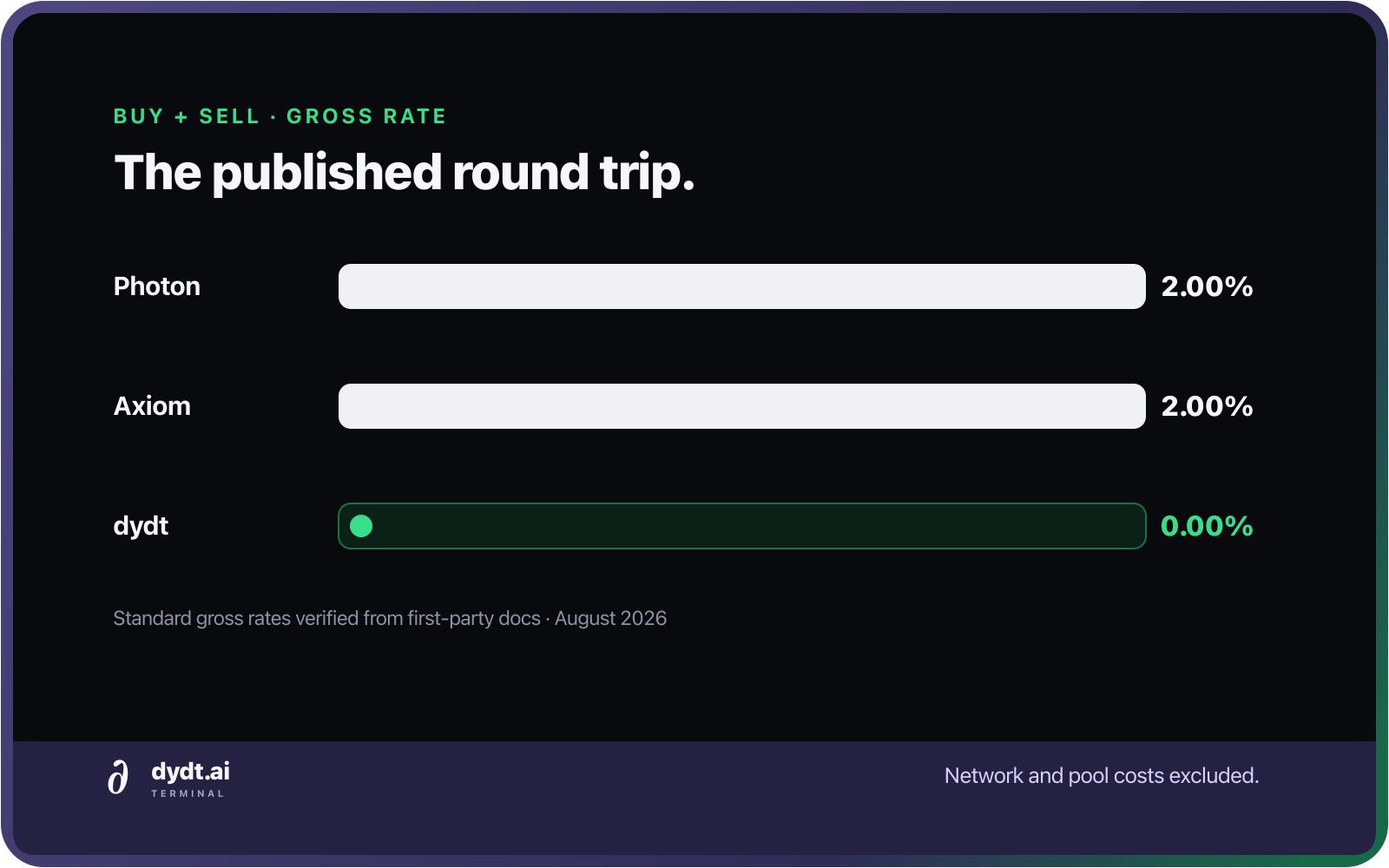
Comparison pages often disagree with primary documentation. Photon publishes 1% on every buy and sell. Axiom's default tier is 0.95% net plus 0.05% cashback—1% gross—and its top volume tier reaches 0.75% net.
| Platform | Per that platform's own docs | Source quality |
|---|---|---|
| Photon | 1% on every buy and every sell | Primary — Photon GitBook |
| Axiom | 1% at default tier (0.95% net + 0.05% cashback); 0.75% net at top tier | Primary — Axiom docs |
Verified August 2026. Rates and tiers change, so check the linked source before trading. We excluded terminals whose current rate we could not confirm from first-party documentation.
At the verified 1% gross rate, fifty $2,000 round trips cost $2,000. That is published math, not a worst-case estimate.
Why terminals charge it anyway
A percentage of every swap is simple billing for expensive infrastructure: RPC, indexing and low-latency data. It also means terminal revenue rises with trade frequency.
dydt will charge eventually. Our order is different: earn the seat first, price it second.
What dydt takes, precisely
During launch, you still pay:
- Solana base and optional priority fees or tips
- Recoverable ATA rent for new token accounts
- The pool's LP fee, price impact and slippage
You pay dydt no percentage fee, added spread, subscription or proceeds deduction. Audit a fill and you will not find a transfer to us.
The launch period, and the part to hold us to
Zero is the launch rate, not a forever promise. If it changes:
- Thirty days of public notice before any platform fee goes live.
- Nothing applied retroactively. Trades executed at zero stay at zero.
- The new rate stays visible on Solscan. No spread folded into the route.
No end date is set. The public ledger makes this commitment independently checkable.
Cost is only one part of execution
A typical memecoin workflow spans a scanner, chart, wallet tracker, explorer, social feed and swap interface. On a ten-minute token, tab switching becomes part of the position.
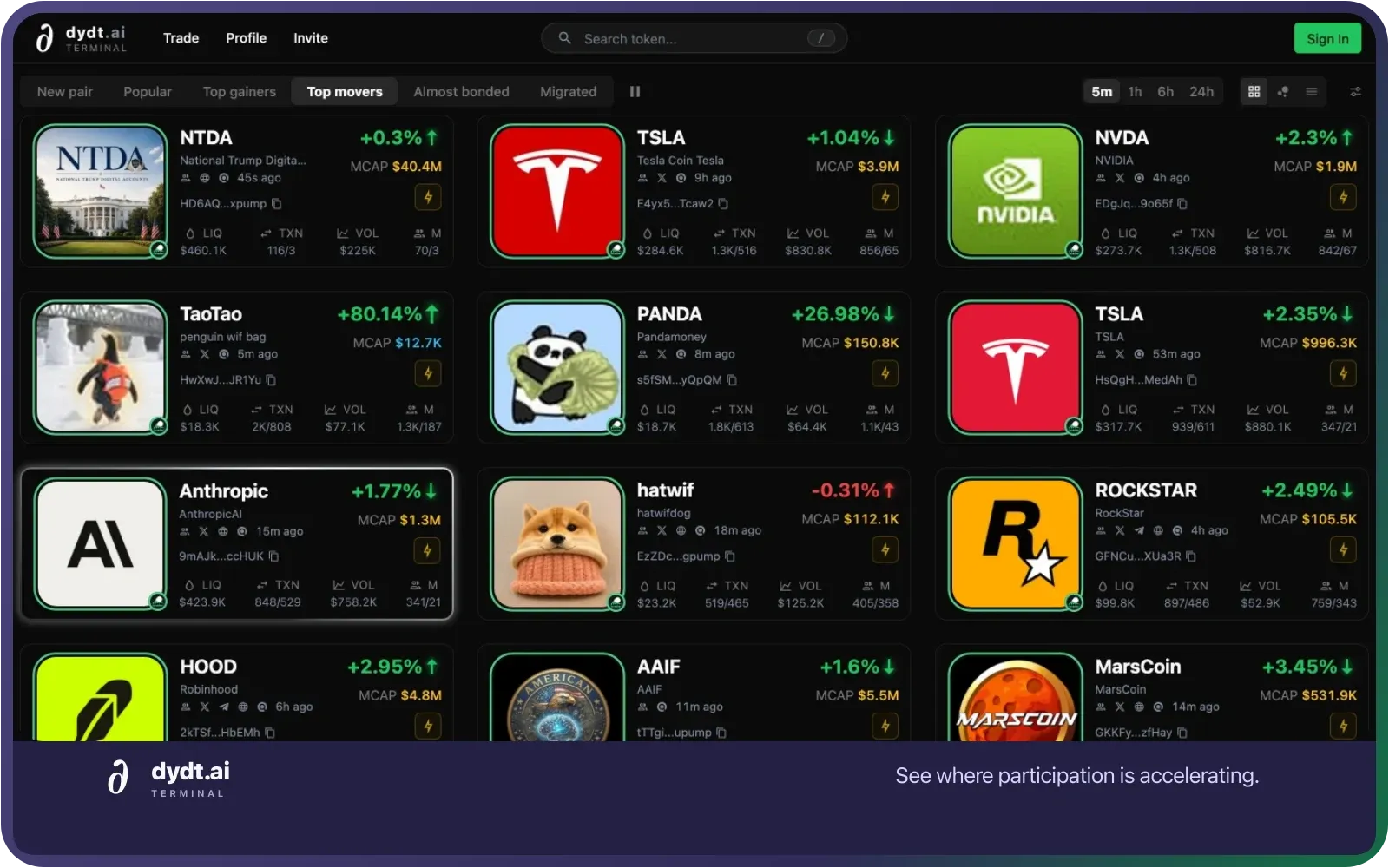
dydt combines discovery, liquidity, transaction flow, charting and trade access. The board ranks change in makers, volume and transactions so you can investigate accelerating participation—not only price that has already moved.
Zero fees is not a strategy
Most memecoins go to zero. Rugs, sniper bundles and coordinated exits are common; saving 2% does nothing for a position that loses 100%.
Zero platform fees provide a lower break-even point and more attempts on the same bankroll. They do not replace risk controls.
Use the launch period to test the terminal. Open dydt.ai, sort by rate of change, then inspect your first fill on Solscan.
The claim is simple: the platform-fee transfer should be absent.
Frequently asked questions
How much does it cost to trade Solana memecoins?
At minimum, you pay 0.000005 SOL per signature, any priority fee, and the pool's LP fee. Photon and Axiom also document a 1% gross standard platform rate. Thin-liquidity price impact may cost more than all of them.
Is dydt really free to trade on?
During launch, dydt charges no percentage fee, added spread or subscription. Network, pool and recoverable ATA costs remain. Verify any fill on Solscan: no transfer should route to dydt.
Which Solana trading bot has the lowest fees?
From first-party sources, Photon publishes 1% per side and Axiom's default is 1% gross. Axiom reaches 0.75% net at its top volume tier. dydt charges 0% during launch. Always re-check current documentation.
How do I check what my current trading terminal charges?
Open a fill on Solscan and read every SOL recipient. A transfer unrelated to your wallet, pool or execution infrastructure is the platform cut. Compare the signed quote with the received amount to check for spread.
How much do platform fees cost an active trader per month?
Use position size × 2 × fee rate × round trips. At $2,000, 1%, and 50 round trips, the platform drag is $2,000 regardless of PnL.
What is ATA rent and can I get it back?
Creating an Associated Token Account deposits 0.00203928 SOL. It is locked, not spent. Close the empty account and the SOL returns to your wallet.
Will dydt add fees later?
Yes, eventually. No end date is set. dydt will give thirty days of public notice, never charge past trades retroactively, and keep any future fee visible on Solscan.
Table of Contents
© dydt.ai — real-time Solana trading terminal. Not financial advice.