Only 3.6% of Pump.fun Coins Graduated, and Almost Half of Those Had One Buyer
On this page
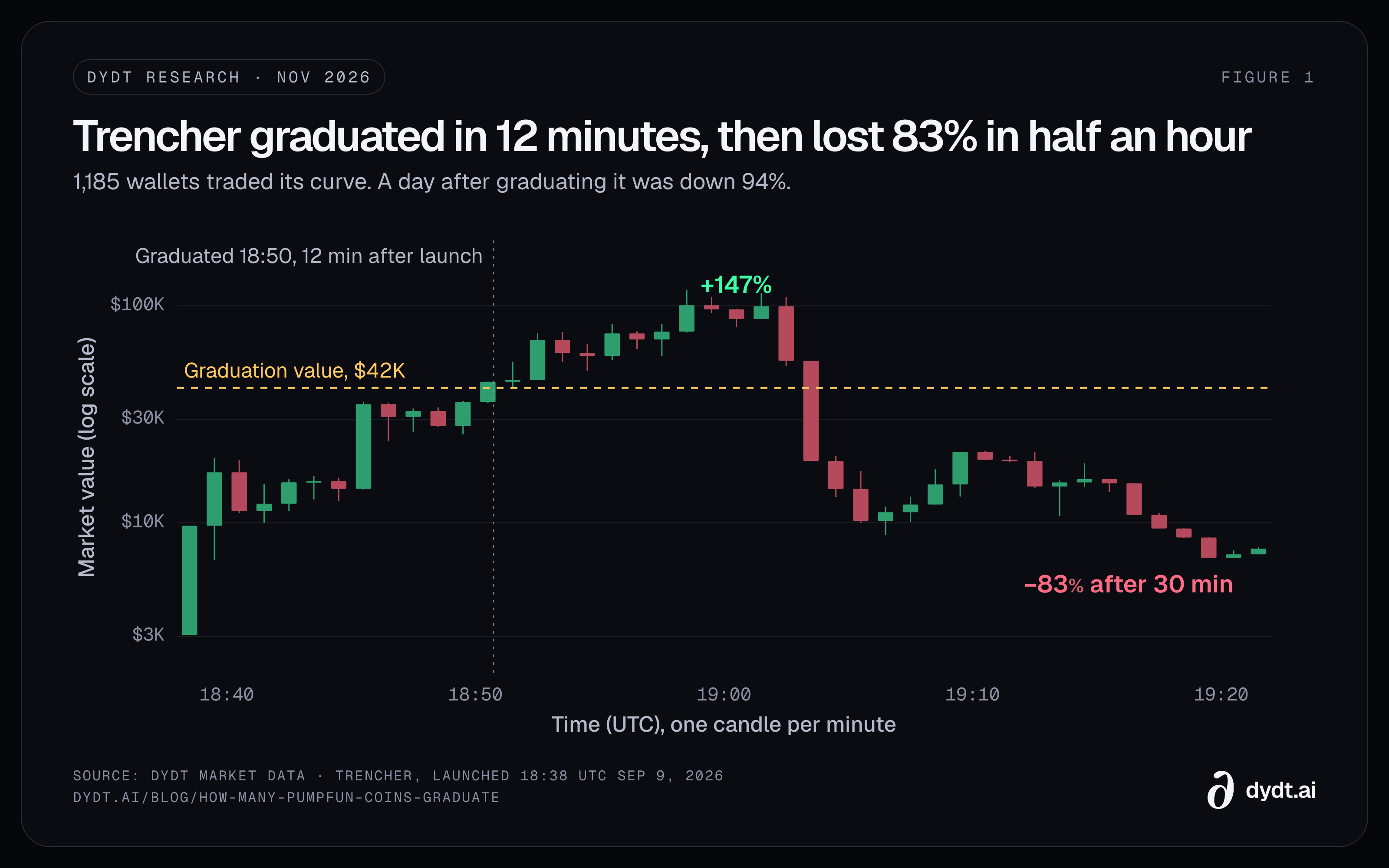
At 18:38 UTC on September 9, 2026, a coin called Trencher went live on pump.fun. Twelve minutes later, after 1,185 wallets had traded it, the last token on its bonding curve was sold and the coin graduated to a trading pool.
Any guesses what happened next?
Ten minutes later it was up 147%. Half an hour after graduating it was down 83%.
Graduation is the moment a pump.fun coin sells out its curve and moves to an open market. It is often read as a sign that a coin has made it.
According to a dydt analysis of on-chain trades, only 3.6% of the 281,429 standard coins launched on pump.fun between September 2 and 15, 2026 graduated. Almost half of those graduations had exactly one buyer, nearly always the coin's own creator. Coins that drew a real crowd, as Trencher did, fell anyway: 94.2% of these slow graduates were worth less a day later.
Key findings
- Only 3.6% of the 281,429 standard pump.fun coins launched Sep 2–15, 2026 graduated.
- The last buyer on a bonding curve pays 14.7 times what the first buyer paid per token.
- 73.7% of graduations happened within 10 seconds of launch.
- 48.4% of graduations had exactly one buyer, and in 4,835 of those 4,839 cases it was the coin's creator.
- 94.2% of slow graduations were worth less a day later, out of the 1,999 coins that took at least a minute to fill their curve.
There is also a seven-minute video of this study on the dydt YouTube channel.
How a pump.fun coin is born
A new pump.fun coin is a name, a picture, one billion tokens and a contract address, and it comes with its own market maker: a bonding curve that sells the first 793.1 million tokens to anyone who buys. Anyone can make one in seconds; in the first two weeks of September about 29,000 pump.fun coins were made every day, Mayhem-mode coins included.
A coin that is one second old has no owners, so there is nobody to sell it to you and nobody to buy it back. The bonding curve fills that gap. It is a program in the coin's contract that sells tokens to buyers and buys them back from sellers.
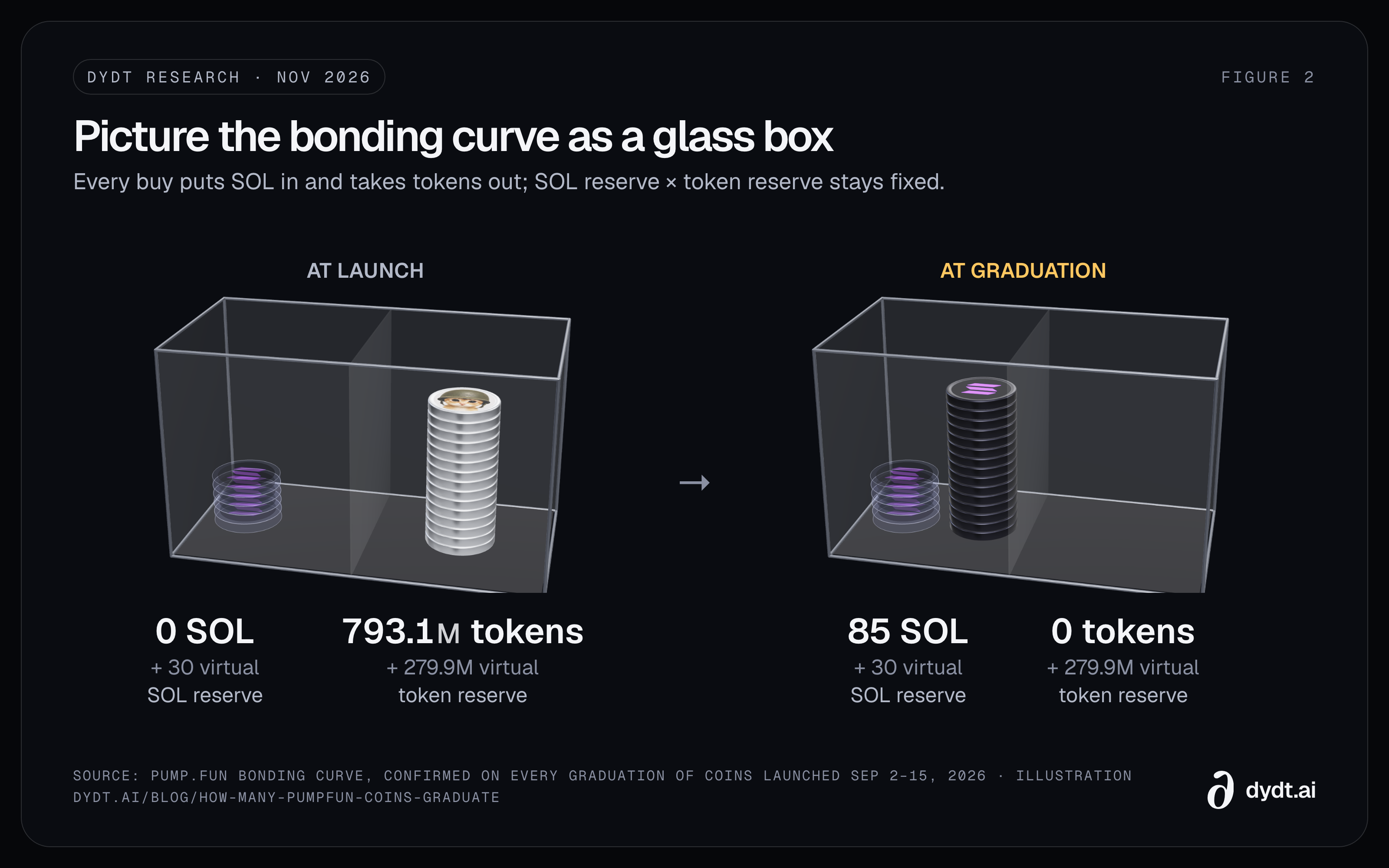
Picture the curve as a glass box with two reserves: SOL on one side, the coin's tokens on the other. At launch the token side holds 793.1 million tokens for sale and the SOL side holds no real SOL. To set a starting price, pump.fun adds virtual amounts to both sides: 30 virtual SOL and 279.9 million virtual tokens. They exist only in the price formula; nobody can buy them or take them out.
One rule sets every price: the SOL reserve times the token reserve, virtual amounts included, always gives the same number. Every buy puts SOL in and takes tokens out, so each token costs more than the last. How much more does the last buyer pay than the first?
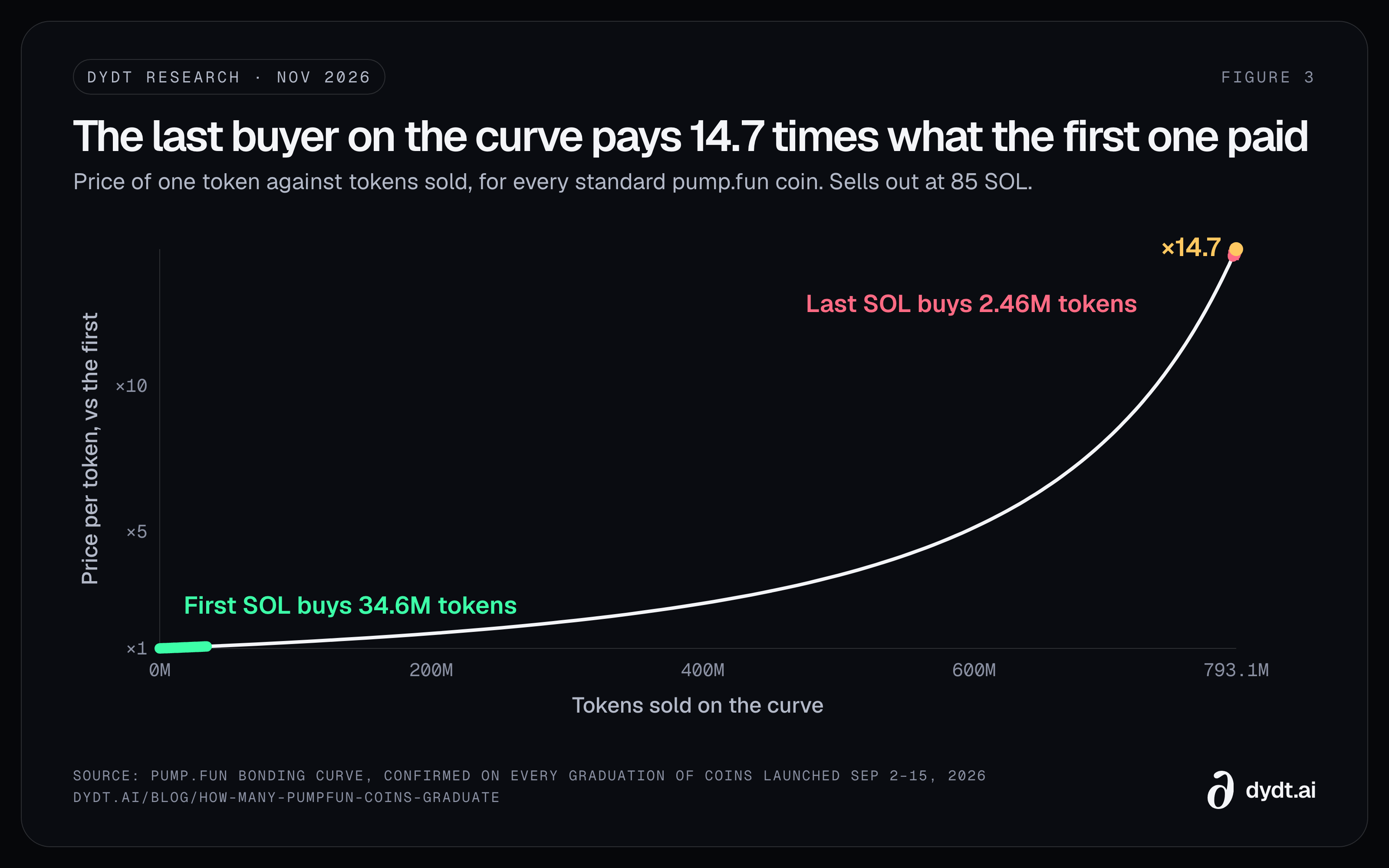
The first SOL buys about 34.6 million tokens. The last one buys about 2.46 million. When 85 SOL has gone in, every token for sale is gone and the coin graduates. Its 85 SOL and the 206.9 million tokens held back from the curve move into a trading pool on PumpSwap, where an ordinary market sets the price.
Only 3.6% make it to the end of the curve
Most coins never come close to graduating: of 281,429 new coins, only 3.6% sold out their curve, and the typical coin stopped at 6.4% of the way. Figure 4 shows where the rest stopped.
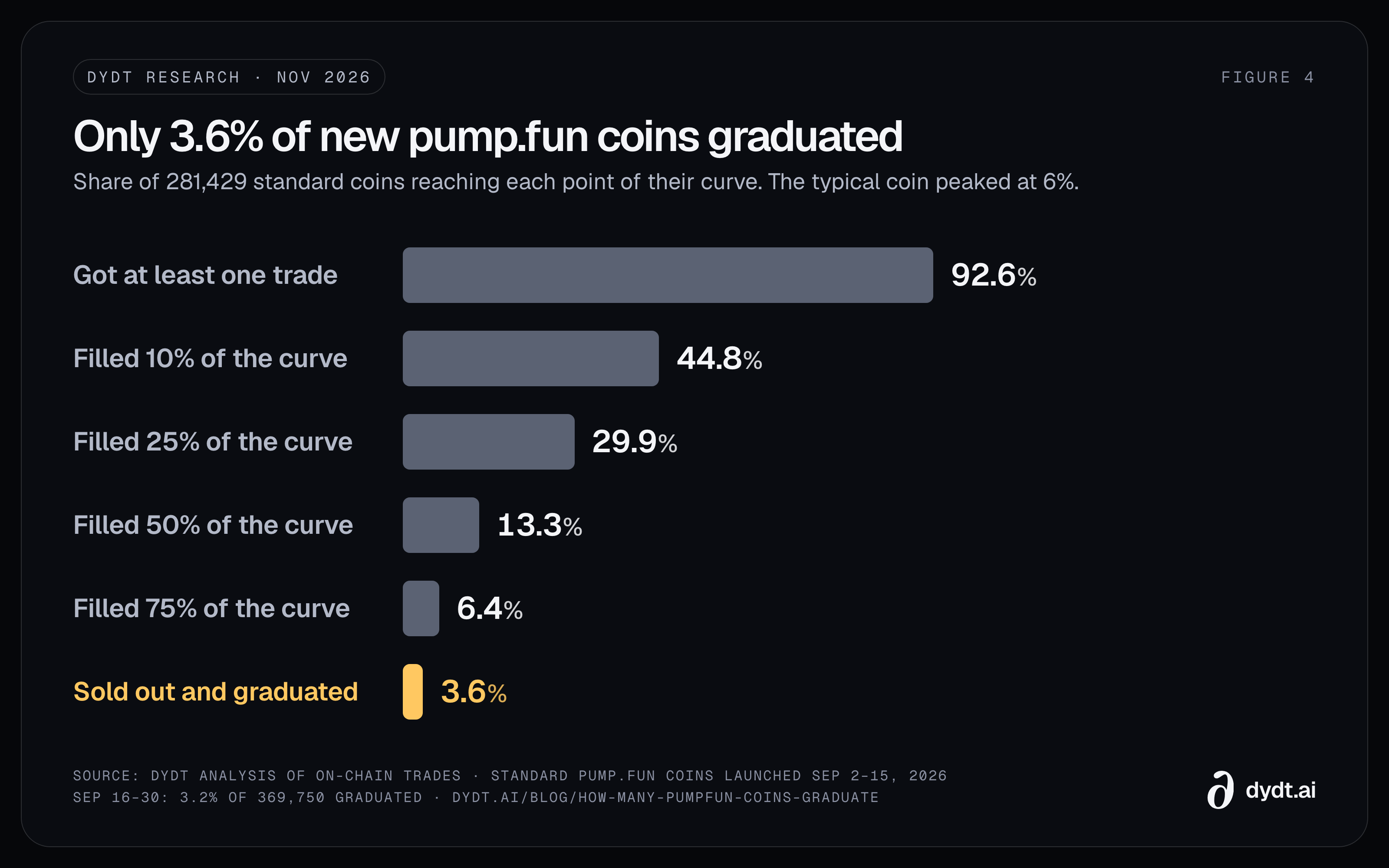
92.6% got at least one trade, and 13.3% got halfway. Only about 10,000 made it all the way and graduated: roughly one coin in every 28 launched. The second half of September told the same story: 3.2% of 369,750 standard coins graduated.
But a graduation does not say who filled the curve. A curve that sells out to a crowd over twelve minutes and one that sells out to a single wallet in one second end in the same place. So how many buyers does it take to graduate a coin? Often, just one.
Almost half of graduations had one buyer
Almost half of all graduations had exactly one buyer on the curve, 4,839 of 10,003, and nearly every one of those buyers was the wallet that created the coin. The exceptions were four wallets out of 4,839.
All of the one-buyer graduations filled within 10 seconds of launch. Add the fast graduations that had a few more buyers, and 73.7% of all graduations filled within 10 seconds.
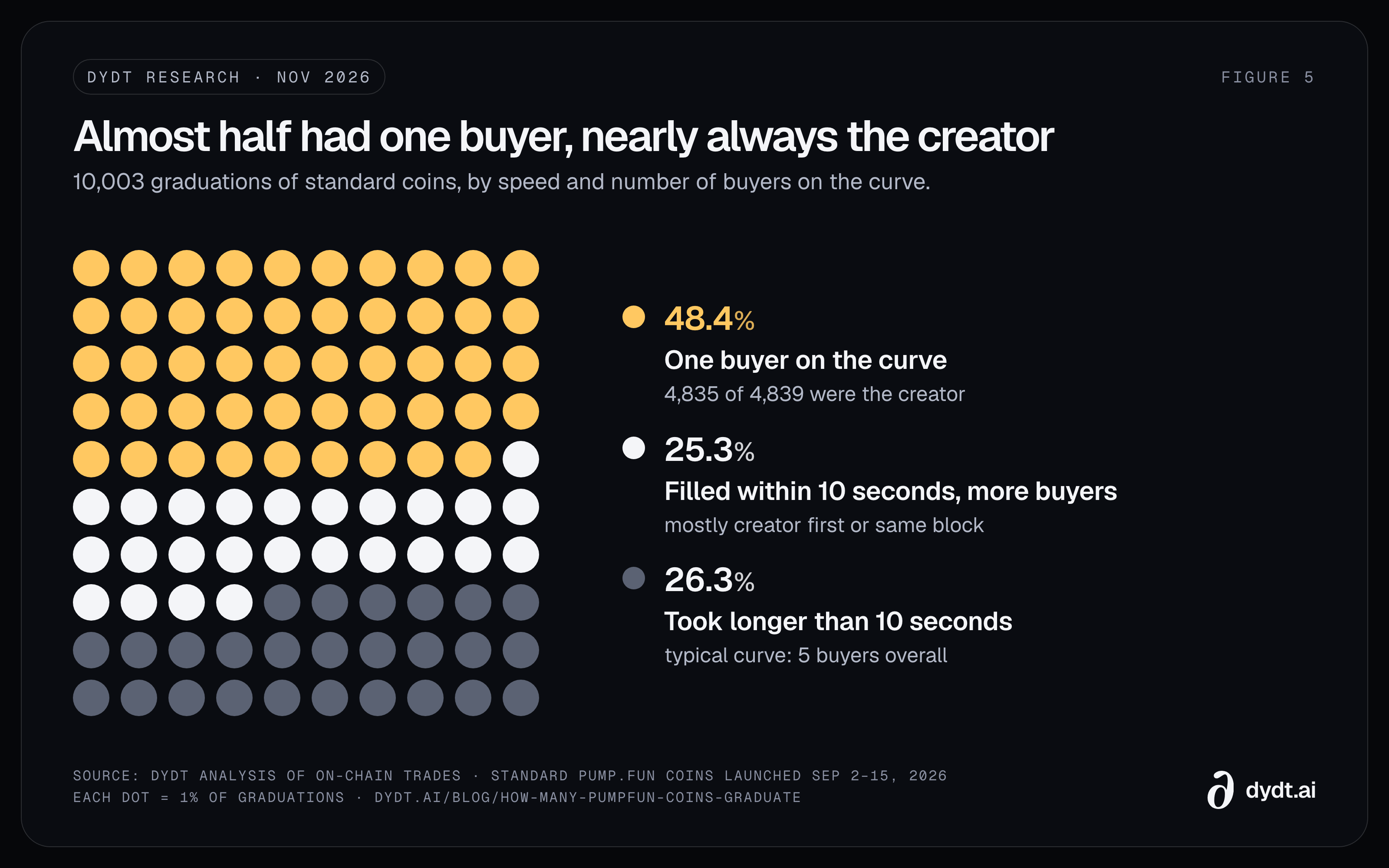
Among the 7,370 graduations that filled within 10 seconds, the first buyer was the creator 71.5% of the time. In almost all the rest, the first buyer bought in the launch's own block, the same fraction of a second.
CORVIN is one of the one-buyer graduations. At 22:24:25 UTC on September 9, in the same second it launched, its creator's wallet bought all 793.1 million tokens on the curve for 86.07 SOL. The coin was a graduate at one second old.
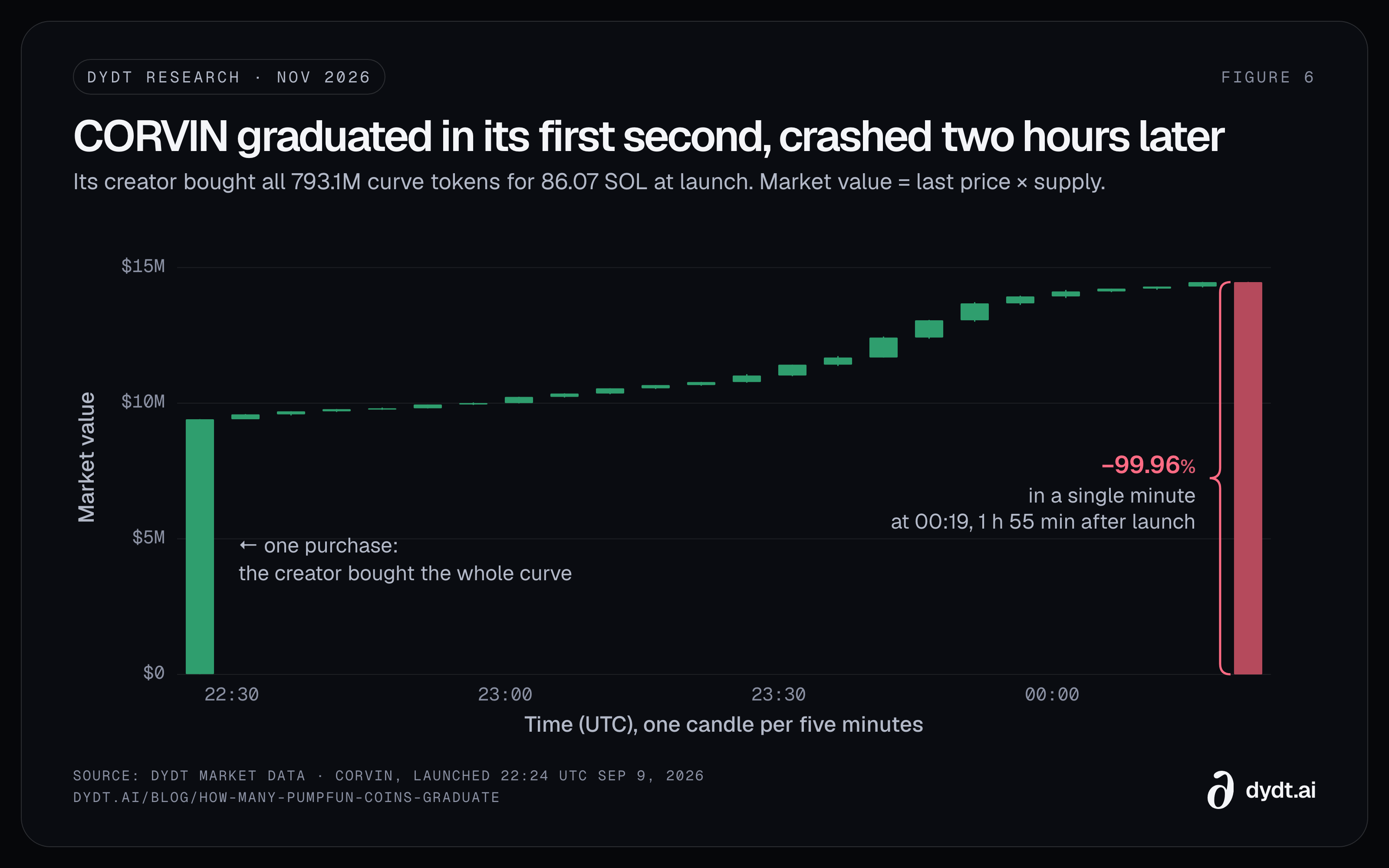
Over the next two days, 11,010 wallets traded CORVIN's pool. Its market value, the last trade's price times the full supply, climbed for almost two hours to about $14.5 million. At 00:19 UTC it fell to about $5,400 in a single minute.
So do coins that graduate the slow way, with a real crowd behind them, hold up any better?
Slow graduates lost most of their value within an hour
Coins that filled their curve slowly fell too: of the 1,999 that took at least a minute to graduate, 94.2% were worth less a day later, and the typical one kept 5.6% of its graduation value. These were coins with real crowds: the typical slow graduation had 409 buyers on its curve.
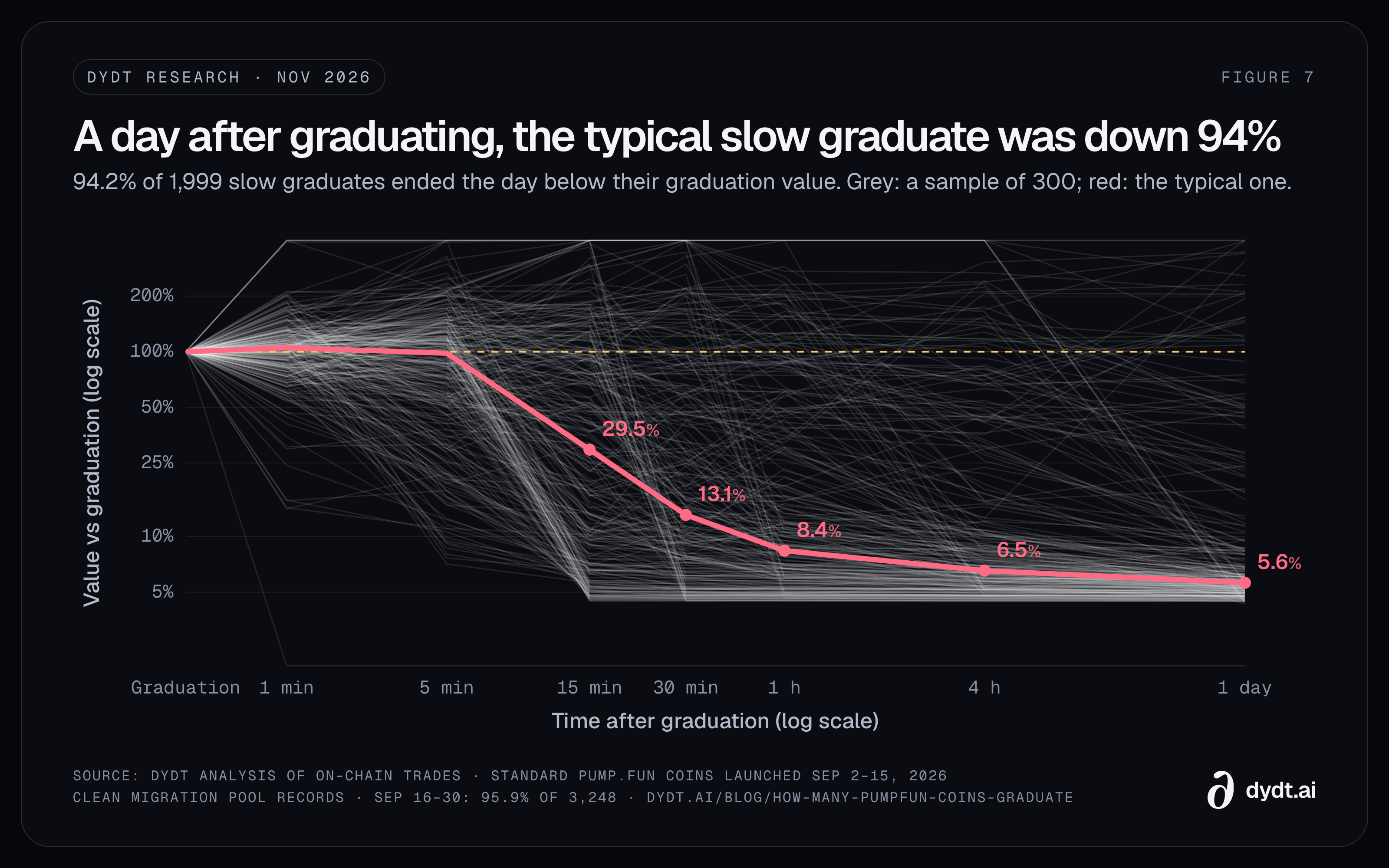
For five minutes the typical coin held near its graduation value. Fifteen minutes in, it was at 29.5%, and after an hour at 8.4%. The second half of September looked the same, with 95.9% lower a day later. The timing fits early buyers taking their exit once the coin trades in an open pool.
Back to Trencher
Trencher is a fair example of a slow graduate. It drew a real crowd, 1,185 wallets in twelve minutes, and graduated the slow way. Its climb to +147% ten minutes in was far above the typical path, which sat near its graduation value at 5 minutes and at 29.5% by 15. What followed was ordinary. Half an hour after graduating it was at 17% of its graduation value, close to the typical 13.1%. A day later it was at 6.4%, against 5.6% for the typical slow graduate.
What this means if you buy memecoins
- A graduation alone tells you little. Almost half of graduations had one buyer, and a coin can graduate in its first second without a single outside buyer.
- Check who filled the curve. On any token page, look at what the creator holds and how many wallets bought on the curve before you buy a fresh graduate.
- Expect most of the drop within 15 minutes. For slow graduates, the typical coin was near its graduation value at 5 minutes and at 29.5% at 15.
- Size every buy for a fast drop. A coin that rose 147% in ten minutes fell below its graduation value in one.
On dydt, every token page shows what the creator holds and every coin the creator has launched before. Open the trenches.
About this research
Why we did this. Graduation is the milestone most new-coin buyers watch. We wanted to measure how often it happens and what follows.
How we did this. We took every pump.fun coin launched between September 2 and 15, 2026 (404,140 coins) and set aside the 122,711 launched in Mayhem mode, where pump.fun's own bot trades the coin and a coin can graduate with almost no SOL. That left 281,429 standard coins.
For each coin we measured its highest point on the curve, whether it graduated, how long the curve took to fill and how many wallets bought on it. For the 1,999 slow graduations with a clean migration pool record, out of 2,257, we compared the pool's market value at fixed times after graduation with the curve's end value.
Definitions.
- Typical: the median, the one in the middle when every coin is lined up from lowest to highest. Half the coins were above it and half below.
- Graduated: the coin's bonding curve sold out and the coin traded on its PumpSwap pool.
- Within 10 seconds: the last token on the curve was sold less than 10 seconds after the coin launched.
- One buyer: exactly one wallet bought on the curve.
- Slow graduation: the curve took at least a minute to fill. The typical one had 409 buyers.
- Worth less a day later: the pool's market value, measured in SOL, was below the curve's end value 24 hours after graduation.
Limitations. Wallets are not people: one person can run several wallets, so "one buyer" means one buying wallet. The after-graduation path covers slow graduations with a clean migration pool record, 89% of them. A market value on a thin pool can be far above what holders could sell for, as CORVIN's chart shows. The study covers two weeks of launches and a replication on the next two weeks.
Replication.
| Sep 2–15 | Sep 16–30 | |
|---|---|---|
| Standard coins launched | 281,429 | 369,750 |
| Graduated | 3.6% | 3.2% |
| Graduations within 10 seconds | 73.7% | 63.6% |
| … with the creator as first buyer | 71.5% | 74.5% |
| Graduations with exactly one buyer | 48.4% | 43.9% |
| Slow graduations worth less a day later | 94.2% | 95.9% |
Data note. Source: dydt analysis of on-chain Solana trades, pump.fun coins launched September 2 to 30, 2026. Coins were followed until October 23, 2026.
How to cite this research
dydt research. "Only 3.6% of Pump.fun Coins Graduated, and Almost Half of Those Had One Buyer." dydt, November 11, 2026. https://dydt.ai/blog/how-many-pumpfun-coins-graduate
Not financial advice. Memecoins can lose all their value, and most of the coins in this study did.
dydt operates a trading terminal, and the pages mentioned here are its own.
Frequently asked questions
How many pump.fun coins graduate?
About 3.6% of standard pump.fun coins launched in early September 2026 graduated, around 10,000 of 281,429. The typical coin stopped at 6.4% of its bonding curve. The second half of September showed 3.2%.
What is the pump.fun bonding curve?
It is a program in each new coin's contract that sells the first 793.1 million tokens and buys them back from sellers. Its price rises with every buy, so the last buyer pays 14.7 times what the first one paid per token. When 85 SOL has gone in, the curve is sold out and the coin graduates.
What happens when a pump.fun coin graduates?
Its 85 SOL and 206.9 million held-back tokens move into a trading pool on PumpSwap, where an open market sets the price. Of the coins that graduated slowly, with real crowds, 94.2% were worth less a day later.
Why do memecoins dump after graduation?
The drop comes fast: the typical slow graduate held its value for five minutes, then was at 29.5% after 15 minutes and 5.6% a day later. That timing fits early buyers selling once the coin trades in an open pool.
Do pump.fun creators buy their own coins?
Often. 48.4% of all graduations in our study had exactly one buyer on the curve, and in 4,835 of those 4,839 cases it was the creator's own wallet.
Table of Contents
© dydt.ai — real-time Solana trading terminal. Not financial advice.